
NABL record checklist
Every record an Indian medical laboratory is expected to produce at assessment — 22 records, 179 required fields, each mapped to the clause that requires it. Built from NABL 112A.
1 · Establish your NABL size class first
It decides which criteria and fee band apply to you. NABL classifies by patients received per day.
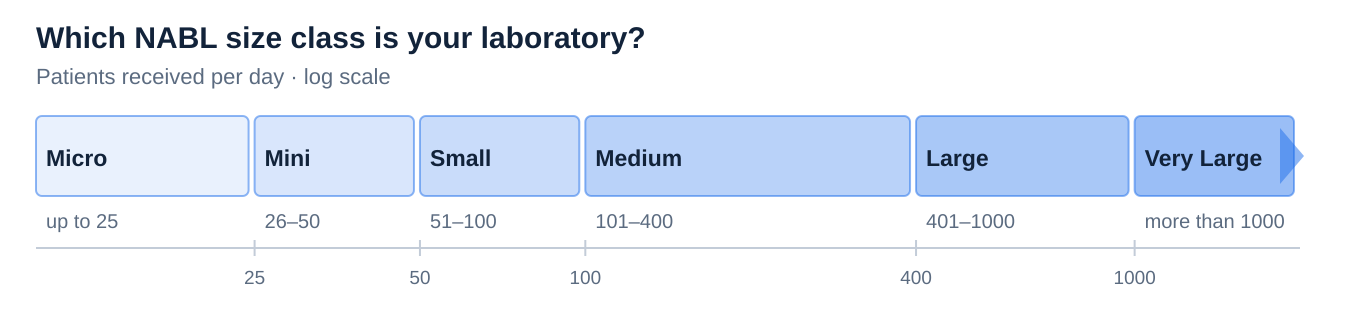
| Class | Patients / day | Yours |
|---|---|---|
| Micro | up to 25 | |
| Mini | 26–50 | |
| Small | 51–100 | |
| Medium | 101–400 | |
| Large | 401–1000 | |
| Very Large | more than 1000 |
Source: NABL 112A, Introduction — NABL's own laboratory size categories, by patients received per day.
2 · Quality management system
NABL Internal Audit Checklist for Medical Laboratories Cl. 8.8.3
Evidence that the laboratory audits its own quality management system against ISO 15189:2022 on a planned schedule, and records what it found.
How often: Planned programme; every clause and every discipline covered across the cycle.
- Audit plan and cycle dates
- Auditor name and independence from the area audited
- Clause audited
- Objective evidence examined
- Conformity / nonconformity against each clause
- Nonconformity reference raised
- Auditee acknowledgement
- Follow-up verification date
Quality Indicators Record Cl. 8.8.2
Numbers the laboratory tracks to show its own processes are under control across the pre-examination, examination and post-examination phases.
How often: Monitored on a defined interval and reviewed at management review.
- Indicator name and the phase it measures
- Definition and formula
- Target or acceptable limit
- Data source
- Period value
- Trend against previous periods
- Action triggered when outside target
- Review at management review
Turnaround Time (TAT) Monitoring Record Cl. 8.8.2
Measured turnaround time against the laboratory's own published commitment, per test and per phase.
How often: Continuously captured; summarised on the quality-indicator interval.
- Test and priority (routine / urgent)
- Published TAT commitment
- Registration time
- Collection time
- Receipt in lab time
- Result authorised time
- Report delivered time
- Achieved TAT and breach flag
- Percentage within commitment for the period
Nonconformity, Corrective Action and CAPA Log Cl. 8.7
The single register where every failure — audit finding, QC breach, EQA failure, complaint, equipment fault — is tracked to a verified close.
How often: Every nonconformity, tracked until effectiveness is verified.
- NC reference number and source
- Date raised and by whom
- Description of the nonconformity
- Immediate containment action
- Impact on patient results and action taken
- Root cause analysis
- Corrective action and owner
- Target and actual closure date
- Verification of effectiveness and by whom
Management Review Record Cl. 8.9
The record of top management formally reviewing the quality management system and deciding on resources and improvement.
How often: At planned intervals, covering every required input.
- Date, attendees and apologies
- Status of actions from the previous review
- Internal and external audit outcomes
- Quality indicator performance
- EQA and IQC performance
- Nonconformities and corrective actions
- User feedback and complaints
- Resource adequacy and risk
- Decisions, actions, owners and dates
3 · Examination and quality control
Internal Quality Control (IQC) Record and Levey–Jennings Chart Cl. 7.3.7.2
Daily proof that each analytical system was in control on the day the patient result was produced.
How often: Two levels of QC on the day of testing, then one level every shift / 8 hours, run at fixed times during operational hours.
- Analyte and instrument
- QC lot and level
- Date, shift and fixed run time
- Observed value
- Laboratory's own mean and SD
- LJ plot point
- Accept / reject decision against defined criteria
- Outlier, trend and shift analysis
- Corrective action taken
- Monthly mean, SD and %CV
EQA / Proficiency Testing Participation Record Cl. 7.3.7.3
Evidence of external verification of the laboratory's performance against peer laboratories.
How often: Per the EQA provider's cycle, for every accredited discipline.
- EQA provider and programme
- Cycle and sample identity
- Reported result and date
- Peer group / assigned value
- Z-score or provider's performance score
- Pass / fail determination
- Root cause where unacceptable
- Documented corrective action
- Verification of effectiveness
Method Verification Record Cl. 7.3.2
Proof that a validated method performs as claimed in THIS laboratory, on THIS instrument, with THIS operator, before patient reporting begins.
How often: Before a method is put into service, and after any change that could affect performance.
- Method, analyte, instrument and reagent lot
- Manufacturer's stated performance claims
- Precision study data
- Trueness / bias against reference
- Reportable range confirmed
- Comparison with the previous method
- Acceptance criteria set in advance
- Conclusion and authorisation to report
- Signature of the person authorising
Method Validation Record Cl. 7.3.3
Required where the laboratory uses a modified, in-house or non-standard method — the laboratory itself must establish the performance characteristics.
How often: Before an in-house or modified method is used for patient reporting.
- Scope of the method and why validation (not verification) applies
- Performance characteristics established
- Analytical specificity and sensitivity
- Linearity and measuring interval
- Precision and trueness
- Interference study
- Acceptance criteria and results
- Validation conclusion and authorisation
Measurement Uncertainty (MU) Record Cl. 7.3.4
A stated, periodically reviewed estimate of the uncertainty attached to each quantitative result.
How often: Established per quantitative analyte and reviewed annually where possible.
- Analyte and measuring system
- IQC data period used
- Routine imprecision (%CV)
- Bias component and its source
- Combined and expanded uncertainty
- Coverage factor stated
- Date calculated and next review
- For qualitative tests: the listed factors contributing to uncertainty
Comparability of Results Record Cl. 7.3.7.4
Evidence that the same analyte measured on different instruments, sites or methods gives comparable results to the clinician.
How often: Defined interval, and whenever an instrument or method is added or changed.
- Analyte and the instruments or sites compared
- Sample set used and concentration span
- Acceptance criteria defined in advance
- Observed differences
- Clinical significance assessment
- Action where criteria not met
- Date and authorising signature
4 · Pre- and post-examination
Sample Rejection Log and Rejection Criteria Cl. 7.2
A defined, written list of what makes a sample unacceptable, plus the log proving the criteria were applied consistently.
How often: Every rejected sample, logged at the point of rejection.
- Date and time of receipt
- Patient and sample identity
- Test requested
- Rejection reason against the written criteria
- Who was informed and when
- Repeat sample requested / received
- Monthly rejection rate as a quality indicator
Primary Sample Collection Manual Cl. 7.2
The instruction set given to whoever collects the sample — container, volume, additive, patient preparation, labelling and transport conditions.
How often: Controlled document, reviewed on the document-control cycle.
- Test name and synonyms
- Specimen type and container / cap colour
- Minimum volume
- Additive or anticoagulant
- Patient preparation (fasting, timing, posture)
- Labelling requirement
- Transport temperature and time limit
- Stability and storage before examination
- Known interferences
Critical Value Notification Log Cl. 7.4.1
Proof that life-threatening results reached a responsible clinician, and how long it took.
How often: Every critical result, logged at the time of notification.
- Patient and sample identity
- Analyte and critical value
- Critical limit breached
- Time result available
- Time notified
- Name and designation of person notified
- Read-back confirmation
- Name of person notifying
- Notification turnaround time
Result Reporting, Review and Release Record Cl. 7.4.1
Evidence of who reviewed and authorised each report before release, and of any amendment after release.
How often: Every report; every amendment.
- Report identity and version
- Reviewer and authoriser identity
- Date and time of authorisation
- Amendment reason where applicable
- Original value retained and traceable
- Who was informed of the amendment
- Where autoverification is used: the rules, their validation and review
Post-Examination Sample Storage and Disposal Record Cl. 7.4.2
Defined retention period and disposal route for examined samples, with the record proving it was followed.
How often: Per retention cycle and at every disposal event.
- Sample type and retention period
- Storage location and temperature
- Retrieval log for add-on tests
- Disposal date and method
- Authorising signature
- Link to biomedical waste route
5 · Resources: people, equipment, facilities
Equipment Calibration and Metrological Traceability Record Cl. 6.5
Evidence that every measuring system is calibrated against material traceable to SI units, with certificates on file.
How often: Per the defined calibration interval and after any repair affecting measurement.
- Equipment identity and location
- Calibration date and next due date
- Calibrator / reference material and lot
- Traceability certificate reference
- Calibrating agency
- Acceptance criteria and result
- Action where out of specification
- Authorising signature
Equipment Inventory and Preventive Maintenance Log Cl. 6.4
A complete register of laboratory equipment with its service history, breakdowns and the action taken on patient results affected.
How often: Inventory kept current; maintenance per schedule; breakdowns logged as they occur.
- Equipment name, make, model, serial number
- Date received and put into service
- Location and responsible person
- Preventive maintenance schedule and completion
- Breakdown date, fault and downtime
- Repair and return-to-service verification
- Assessment of patient results affected
- Decommissioning record
Reagent and Consumable Lot Verification Record Cl. 6.6
Evidence that a new lot or shipment performed acceptably before it was used on patient samples.
How often: Every new lot and every new shipment.
- Reagent name, manufacturer, lot and expiry
- Date received and storage condition on receipt
- Date placed in service
- Parallel testing against the in-use lot
- Acceptance criteria and observed difference
- Accept / reject decision
- Authorising signature
- Stock and consumption record
Facility and Environmental Condition Monitoring Log Cl. 6.3
Continuous proof that refrigerators, freezers, incubators and the laboratory environment stayed inside the limits the methods require.
How often: Per defined monitoring interval, with excursions actioned as they occur.
- Unit identity and location
- Acceptable range
- Reading, date, time and recorder identity
- Calibrated thermometer reference
- Excursion flag
- Action taken on excursion
- Assessment of stored material affected
- Periodic review signature
Personnel Competency Assessment and Training Record Cl. 6.2
Evidence that each person performing an activity was assessed as competent to perform it, and reassessed at defined intervals.
How often: On induction, after training, and at the defined reassessment interval.
- Person, designation and qualification
- Authorised activities and scope
- Assessment method (direct observation, record review, blind sample, written)
- Assessor identity
- Assessment date and outcome
- Reassessment due date
- Training undertaken and effectiveness evaluation
- Job description acknowledgement
6 · Indian statutory
Biomedical Waste Register and Segregation Chart BMW Rules 2016
Statutory Indian record of biomedical waste generated, segregated by category and handed to the authorised common treatment facility.
How often: Daily generation record; returns per the Rules.
- Date and generating area
- Waste category and colour-coded container
- Quantity in kilograms
- Handover date and authorised CBWTF
- Manifest / consignment reference
- Authorised signatory
- Annual return reference
7 · Discipline-specific criteria that apply on top
NABL 112A section 7 adds requirements per accredited discipline. These sit on top of everything above, not instead of it.
- Clinical Biochemistry Cl. 7.1
- Clinical Pathology Cl. 7.2
- Haematology & Immunohaematology Cl. 7.3
- Microbiology & Infectious Disease Serology Cl. 7.4
- Histopathology Cl. 7.5
- Cytopathology Cl. 7.6
- Flow Cytometry Cl. 7.7
- Molecular Diagnostics Cl. 7.8
- Histocompatibility and Immunogenetics Cl. 7.9
- Cytogenetics Cl. 7.10
- Point of Care Testing (POCT) Cl. 7.11