
Primary Sample Collection Manual
Required by: ISO 15189:2022 Cl. 7.2 — Pre-examination processes
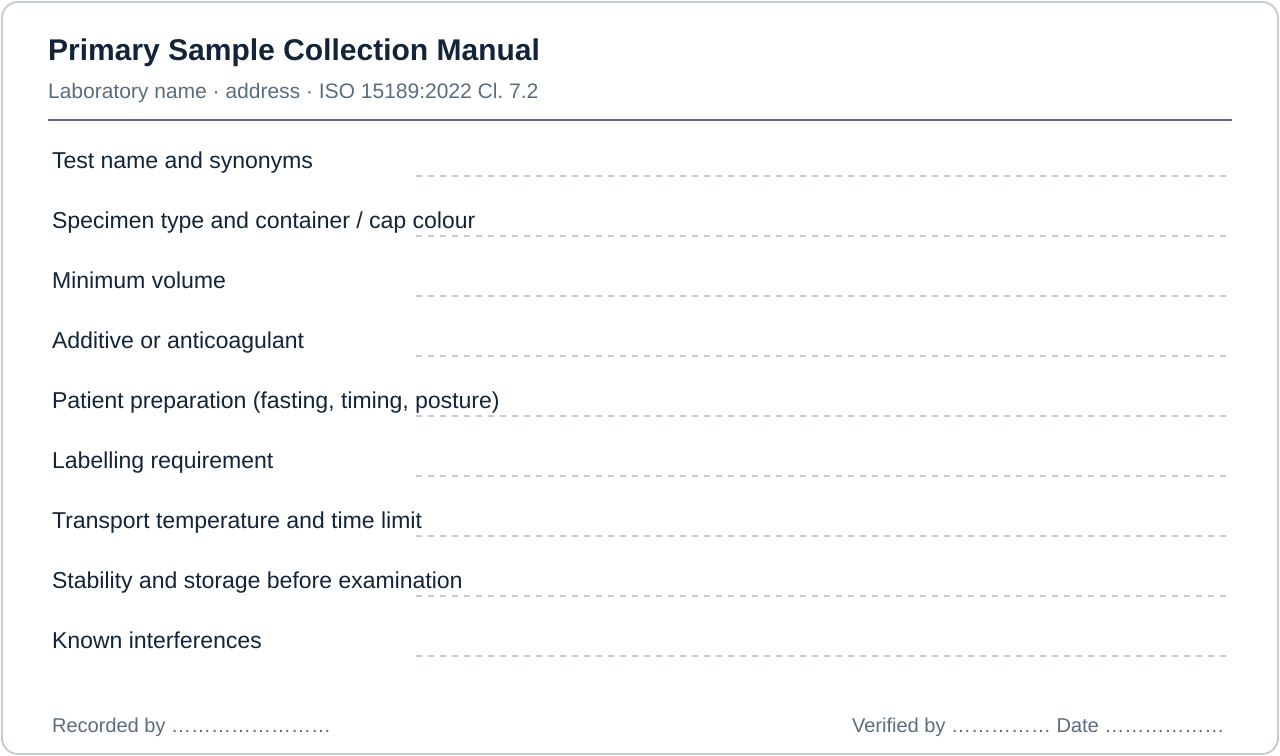
The instruction set given to whoever collects the sample — container, volume, additive, patient preparation, labelling and transport conditions.
Checked against NABL 112A (Issue 01, 18-Dec-2024) · page updated 23 September 2026
How often it must be recorded
Controlled document, reviewed on the document-control cycle.
Every field this record must carry
An assessor reads the record, not the intention behind it. A field left off the form is a finding, however well the work was actually done.
- Test name and synonyms
- Specimen type and container / cap colour
- Minimum volume
- Additive or anticoagulant
- Patient preparation (fasting, timing, posture)
- Labelling requirement
- Transport temperature and time limit
- Stability and storage before examination
- Known interferences
What NABL 112A actually says
Anchored to ISO 15189:2022 Cl. 7.2 pre-examination requirements as carried in NABL 112A. This is the document collection centres and phlebotomists actually work from.
Source: NABL 112A — Specific Criteria for Accreditation of Medical Laboratories, Issue 01, 18-Dec-2024, 108pp. Downloaded from nabl-india.org 2026-09-23. Paraphrased with attribution. ISO 15189:2022 clause numbers and titles are cited as references; the standard's text is copyrighted and is not reproduced here.
What an assessor actually asks for
Reasoning from the clause, not from a published checklist — NABL does not publish assessor scripts. Treat this as how the requirement is normally evidenced.
- The record itself, for a period they choose — not a blank template.
- Completeness across the period. Gaps are the finding; a perfect January and an empty March reads worse than a consistently modest record.
- Who recorded and who verified, with dates. An unsigned record is not evidence that the work was checked.
- The linked procedure — the SOP that says this record must exist, at this frequency, in this format.
- What happened when it went wrong. Every record above has a failure path, and the action taken is usually the part that is missing.
Records this one depends on
Where the software fits
HealthFlow is lab software, not an accreditation body. It is not NABL accredited and using it does not make a laboratory accredited or compliant — the records above are the laboratory's own responsibility.
What it does do is produce some of this evidence as a by-product of normal work: turnaround time is measured per test on the owner dashboard, reports are versioned and locked on authorisation with dual signatures, every report access is written to an append-only audit trail enforced at the database, retained two years, and all of it exports at any time.