
The NABL record kit
Accreditation is assessed on records. These are the 22 a medical laboratory in India is expected to be able to produce, each mapped to the clause that requires it and the fields it has to carry. Sourced from NABL 112A, the Specific Criteria for Accreditation of Medical Laboratories.
Get the whole thing as one printable checklist → All 22 records, 179 fields, one page. Free, no signup.
NABL accreditation is something a lab chooses to seek. Registration under the Clinical Establishments Act is required in the states that have adopted it, with its own minimum standards: what the Act asks of a diagnostic lab →
First, which size is your laboratory?
NABL classifies medical laboratories by the number of patients received per day. The class decides which criteria and which fee band apply to you, so it is the first thing to establish.
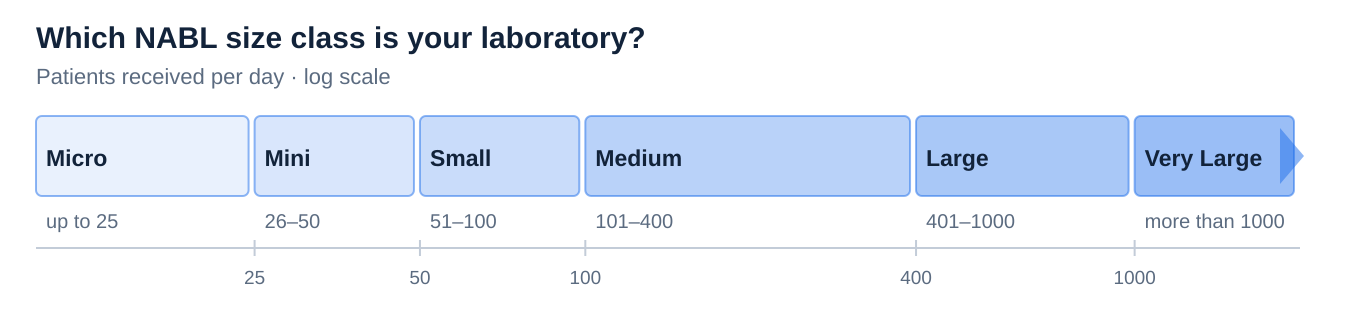
| NABL class | Patients received per day |
|---|---|
| Micro | up to 25 |
| Mini | 26–50 |
| Small | 51–100 |
| Medium | 101–400 |
| Large | 401–1000 |
| Very Large | more than 1000 |
Source: NABL 112A, Introduction — NABL's own laboratory size categories, by patients received per day.
Quality system
- NABL Internal Audit Checklist for Medical Laboratories Cl. 8.8.3
Evidence that the laboratory audits its own quality management system against ISO 15189:2022 on a planned schedule, and records what it found.
- Quality Indicators Record Cl. 8.8.2
Numbers the laboratory tracks to show its own processes are under control across the pre-examination, examination and post-examination phases.
- Turnaround Time (TAT) Monitoring Record Cl. 8.8.2
Measured turnaround time against the laboratory's own published commitment, per test and per phase.
- Nonconformity, Corrective Action and CAPA Log Cl. 8.7
The single register where every failure — audit finding, QC breach, EQA failure, complaint, equipment fault — is tracked to a verified close.
- Management Review Record Cl. 8.9
The record of top management formally reviewing the quality management system and deciding on resources and improvement.
Examination and quality control
- Internal Quality Control (IQC) Record and Levey–Jennings Chart Cl. 7.3.7.2
Daily proof that each analytical system was in control on the day the patient result was produced.
- EQA / Proficiency Testing Participation Record Cl. 7.3.7.3
Evidence of external verification of the laboratory's performance against peer laboratories.
- Method Verification Record Cl. 7.3.2
Proof that a validated method performs as claimed in THIS laboratory, on THIS instrument, with THIS operator, before patient reporting begins.
- Method Validation Record Cl. 7.3.3
Required where the laboratory uses a modified, in-house or non-standard method — the laboratory itself must establish the performance characteristics.
- Measurement Uncertainty (MU) Record Cl. 7.3.4
A stated, periodically reviewed estimate of the uncertainty attached to each quantitative result.
- Comparability of Results Record Cl. 7.3.7.4
Evidence that the same analyte measured on different instruments, sites or methods gives comparable results to the clinician.
Pre- and post-examination
- Sample Rejection Log and Rejection Criteria Cl. 7.2
A defined, written list of what makes a sample unacceptable, plus the log proving the criteria were applied consistently.
- Primary Sample Collection Manual Cl. 7.2
The instruction set given to whoever collects the sample — container, volume, additive, patient preparation, labelling and transport conditions.
- Critical Value Notification Log Cl. 7.4.1
Proof that life-threatening results reached a responsible clinician, and how long it took.
- Result Reporting, Review and Release Record Cl. 7.4.1
Evidence of who reviewed and authorised each report before release, and of any amendment after release.
- Post-Examination Sample Storage and Disposal Record Cl. 7.4.2
Defined retention period and disposal route for examined samples, with the record proving it was followed.
Resources
- Equipment Calibration and Metrological Traceability Record Cl. 6.5
Evidence that every measuring system is calibrated against material traceable to SI units, with certificates on file.
- Equipment Inventory and Preventive Maintenance Log Cl. 6.4
A complete register of laboratory equipment with its service history, breakdowns and the action taken on patient results affected.
- Reagent and Consumable Lot Verification Record Cl. 6.6
Evidence that a new lot or shipment performed acceptably before it was used on patient samples.
- Facility and Environmental Condition Monitoring Log Cl. 6.3
Continuous proof that refrigerators, freezers, incubators and the laboratory environment stayed inside the limits the methods require.
- Personnel Competency Assessment and Training Record Cl. 6.2
Evidence that each person performing an activity was assessed as competent to perform it, and reassessed at defined intervals.
Indian statutory
- Biomedical Waste Register and Segregation Chart BMW Rules 2016
Statutory Indian record of biomedical waste generated, segregated by category and handed to the authorised common treatment facility.
HealthFlow is not NABL accredited and is not an accreditation body. Nothing here makes a laboratory accredited or compliant — these records are the laboratory's own responsibility. This kit exists because the criteria are published as a 108-page PDF and nobody had laid them out record by record.
NABL 112A — Specific Criteria for Accreditation of Medical Laboratories, Issue 01, 18-Dec-2024, 108pp. Downloaded from nabl-india.org 2026-09-23. ISO 15189:2022 clause numbers and titles are cited as references; the standard is copyrighted and its text is not reproduced.