
Method Verification Record
Required by: ISO 15189:2022 Cl. 7.3.2 — Verification of examination methods
Proof that a validated method performs as claimed in THIS laboratory, on THIS instrument, with THIS operator, before patient reporting begins.
Checked against NABL 112A (Issue 01, 18-Dec-2024) · page updated 23 September 2026
How often it must be recorded
Before a method is put into service, and after any change that could affect performance.
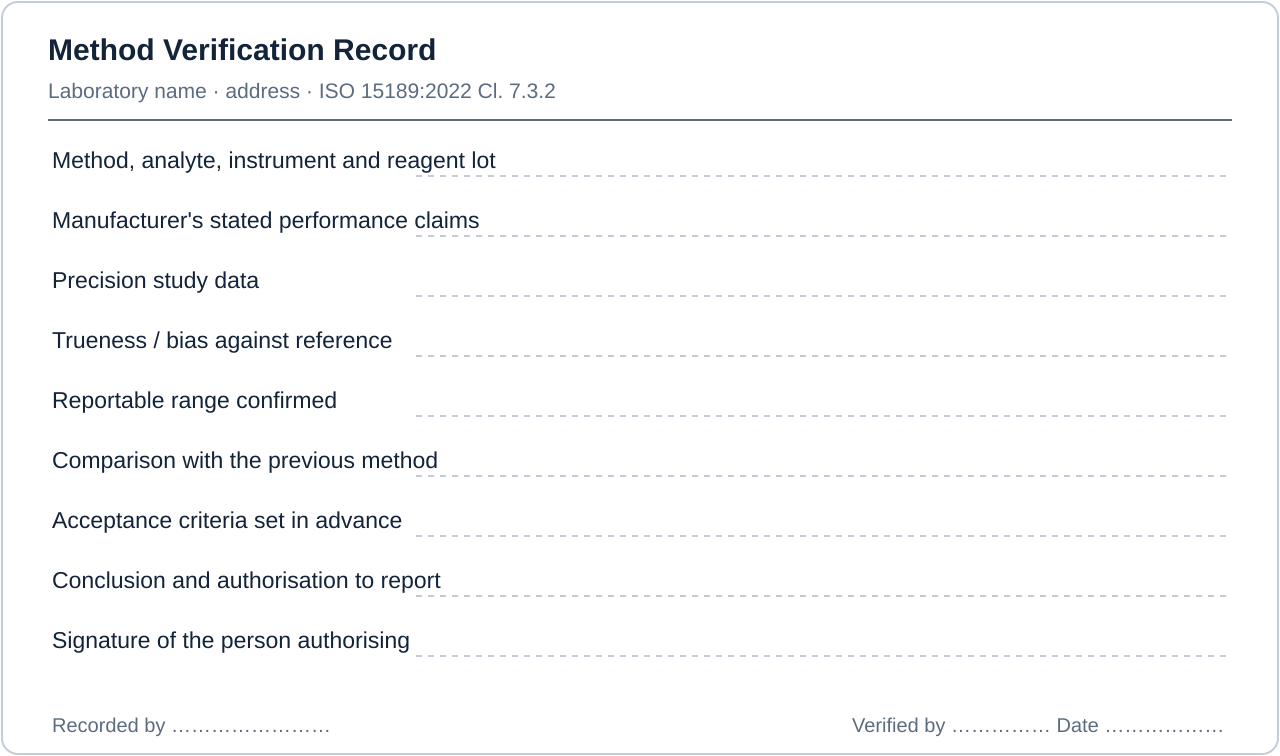
Every field this record must carry
An assessor reads the record, not the intention behind it. A field left off the form is a finding, however well the work was actually done.
- Method, analyte, instrument and reagent lot
- Manufacturer's stated performance claims
- Precision study data
- Trueness / bias against reference
- Reportable range confirmed
- Comparison with the previous method
- Acceptance criteria set in advance
- Conclusion and authorisation to report
- Signature of the person authorising
What NABL 112A actually says
NABL 112A carries Verification of examination methods as a titled requirement block anchored to ISO 15189:2022 Cl. 7.3.2, distinct from validation.
Source: NABL 112A — Specific Criteria for Accreditation of Medical Laboratories, Issue 01, 18-Dec-2024, 108pp. Downloaded from nabl-india.org 2026-09-23. Paraphrased with attribution. ISO 15189:2022 clause numbers and titles are cited as references; the standard's text is copyrighted and is not reproduced here.
What an assessor actually asks for
Reasoning from the clause, not from a published checklist — NABL does not publish assessor scripts. Treat this as how the requirement is normally evidenced.
- The record itself, for a period they choose — not a blank template.
- Completeness across the period. Gaps are the finding; a perfect January and an empty March reads worse than a consistently modest record.
- Who recorded and who verified, with dates. An unsigned record is not evidence that the work was checked.
- The linked procedure — the SOP that says this record must exist, at this frequency, in this format.
- What happened when it went wrong. Every record above has a failure path, and the action taken is usually the part that is missing.
Records this one depends on
- Method Validation Record Cl. 7.3.3
- Measurement Uncertainty (MU) Record Cl. 7.3.4
Where the software fits
HealthFlow is lab software, not an accreditation body. It is not NABL accredited and using it does not make a laboratory accredited or compliant — the records above are the laboratory's own responsibility.
What it does do is produce some of this evidence as a by-product of normal work: turnaround time is measured per test on the owner dashboard, reports are versioned and locked on authorisation with dual signatures, every report access is written to an append-only audit trail enforced at the database, retained two years, and all of it exports at any time.