
Clinical Establishments Act: what it asks of a diagnostic lab
The Clinical Establishments (Registration and Regulation) Act, 2010 requires every lab in an adopting state to register, and since 2018 it has set minimum standards for diagnostic labs in three tiers: basic composite, medium and advanced. Below: whether it applies to you, how registration works, the full standards checklist, and who may sign a report. Each point is taken from the Act or the Gazette, not from a summary.
Does it apply to your lab?
Yes, if your state has adopted it. Section 2(c)(ii) covers any place where pathological, bacteriological, genetic, radiological, chemical or biological investigations are carried on with laboratory equipment, standalone or inside a hospital or clinic.
Adopted in 19 States and UTs (central portal, 26 Sep 2026): Arunachal Pradesh, Assam, Bihar, Haryana, Himachal Pradesh, Jharkhand, Mizoram, Rajasthan, Sikkim, Telangana, Uttar Pradesh, Uttarakhand, and all Union Territories except the NCT of Delhi. Labs in Hyderabad fall under it, since Telangana is on the list. Other states regulate labs under their own laws.
What the Act says, section by section
- s.2(c)(ii) Covers labs
- A clinical establishment includes a place, independent or part of a hospital or clinic, where pathological, bacteriological, genetic, radiological, chemical, biological investigations or other diagnostic or investigative services are usually carried on with the aid of laboratory or other medical equipment.
- s.11 Registration is mandatory
- No person shall run a clinical establishment unless it has been duly registered under the Act.
- s.12 Conditions
- To register and stay registered, the establishment must meet the prescribed minimum standards of facilities and services, minimum personnel, and provisions for maintaining records and reporting.
- s.14–15 Provisional registration
- Apply in the prescribed form with the fee, in person, by post or online. The authority grants a provisional certificate within ten days, without prior inquiry (s.16).
- s.17 Valid 12 months
- A provisional registration is valid to the last day of the twelfth month from issue, and is renewable.
- s.18 Display it
- The certificate must be affixed in a conspicuous place, visible to everyone visiting the establishment.
- s.23 Provisional has a time limit
- Once standards for a category are notified, provisional registration cannot be granted or renewed beyond two years from notification for establishments that already existed, or six months for those set up after notification. Permanent registration then applies (s.24–30).
- s.41 Penalty for running unregistered
- Up to ₹50,000 for the first contravention, up to ₹2 lakh for the second, up to ₹5 lakh for any later one. Knowingly working in an unregistered establishment: up to ₹25,000.
- s.43 Minor deficiencies
- Deficiencies that pose no imminent danger to patients and can be put right in reasonable time: fine up to ₹10,000.
Which tier is your lab?
The 2018 Schedule sorts labs by the tests they run. A lab doing routine biochemistry, haemograms and urine routine is a basic composite lab; the tiers above add to it.
| Area | Basic composite | Medium | Advanced |
|---|---|---|---|
| Biochemistry | Routine tests: blood sugar, renal and liver function, amylase, lipase, lipid profile, CSF and other fluids (glucose, protein), OGTT, electrolytes, calcium or phosphate, HbA1c, any biochemistry rapid test | Adds hormone bioassay, tumour markers, plasma protein electrophoresis | Adds coagulation profile, drug monitoring and toxicology, molecular genetics, inborn errors of metabolism |
| Haematology | Haemogram, bleeding time, clotting time, PT, APTT, blood grouping and matching | Adds coagulation assay | All other haematology tests |
| Histopathology | None | May do, subject to equipment and specialist | Histopathology examination |
| Molecular genetics | None | May do, subject to equipment and specialist | Molecular genetics |
| Cytopathology | None | PAP smear, FNAC, sputum and CSF cytology | Immunocytochemistry, other fluid cytology, ultrasound- or CT-guided FNAC |
| Immunohistopathology | None | None | Immunohistochemistry |
| Microbiology and immunology | Rapid point-of-care tests for infection, urine routine and microscopy, hanging drop for V. cholerae, stool for ova and cyst. All HIV-positive rapid assays confirmed at the next-level lab | Adds serology for viruses, bacteria, fungi, parasites; bacterial or fungal culture sensitivity; special stains beyond Gram's | Adds viral culture sensitivity, RT-PCR, tissue diagnosis for infectious diseases |
The minimum standards checklist
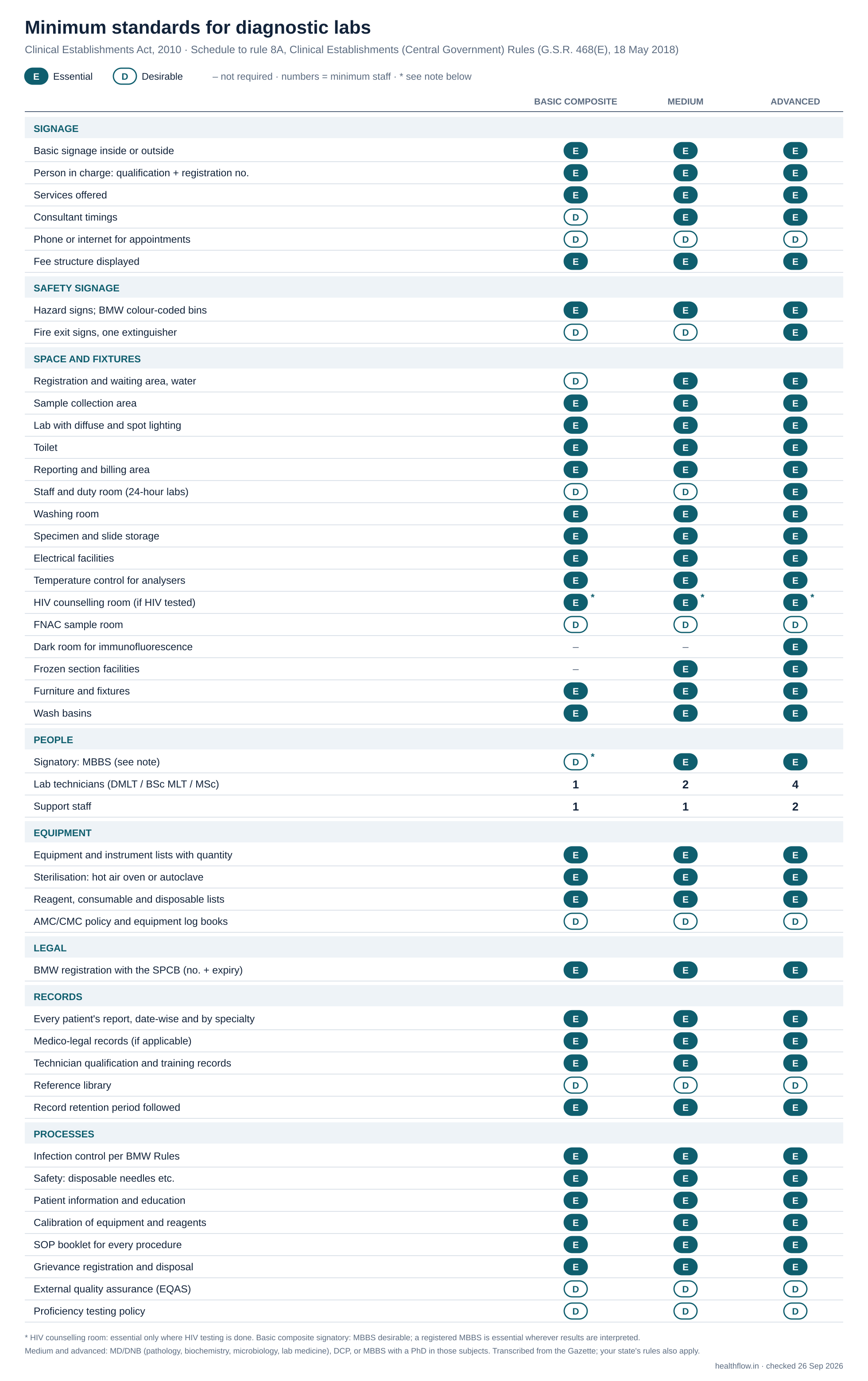
Signage
| Requirement | Basic composite | Medium | Advanced |
|---|---|---|---|
| Basic signage within or outside the facility | Essential | Essential | Essential |
| Name of the person in charge, with qualification and registration number | Essential | Essential | Essential |
| Broad services provided (haematology, biochemistry, clinical pathology, histology, cytology, molecular genetics, whichever apply) | Essential | Essential | Essential |
| Timings of the different consultants | Desirable | Essential | Essential |
| Internet facility, or telephone and mobile number for appointment | Desirable | Desirable | Desirable |
| Fee structure displayed separately, with the type of investigation and charges, special and routine | Essential | Essential | Essential |
Safety signage
| Requirement | Basic composite | Medium | Advanced |
|---|---|---|---|
| Safety hazard and caution signs; biomedical waste segregated in coloured bins and bags as per the BMW Rules 2016, including radioactive, toxic, microbial and infected material | Essential | Essential | Essential |
| Appropriate fire exit signage, minimum one fire extinguisher | Desirable | Desirable | Essential |
Space and fixtures
| Requirement | Basic composite | Medium | Advanced |
|---|---|---|---|
| Registration and waiting room, public utilities, safe drinking water | Desirable | Essential | Essential |
| Sample collection area | Essential | Essential | Essential |
| Laboratory with adequate diffuse and spot lighting | Essential | Essential | Essential |
| Toilet | Essential | Essential | Essential |
| Reporting and billing area | Essential | Essential | Essential |
| Staff room and doctor's duty room, separate for men and women where 24-hour services are available | Desirable | Desirable | Essential |
| Washing room | Essential | Essential | Essential |
| Preservation of specimens and slides | Essential | Essential | Essential |
| Electrical facilities | Essential | Essential | Essential |
| Temperature control for specialised equipment such as flow cytometry, chemiluminescence and ELISA | Essential | Essential | Essential |
| Counselling room for HIV, essential if HIV testing is done | Essential (see note) | Essential (see note) | Essential (see note) |
| FNAC room for sample collection | Desirable | Desirable | Desirable |
| Dark room for immunofluorescence | Not required | Not required | Essential |
| Frozen section facilities | Not required | Essential | Essential |
| Furniture and fixtures (medium and advanced: as per scope of services) | Essential | Essential | Essential |
| Wash basins | Essential | Essential | Essential |
People
| Requirement | Basic composite | Medium | Advanced |
|---|---|---|---|
| Technical head or authorised signatory. Basic composite: MBBS desirable, and a registered MBBS is essential wherever results are interpreted or an opinion is given. Medium and advanced: MD or DNB in pathology, biochemistry, microbiology or laboratory medicine, or DCP, or MBBS with a PhD in one of those subjects, is essential. The authorised signatory is liable for the authenticity of the report. | Desirable (see note) | Essential | Essential |
| Laboratory technicians with DMLT, B.Sc. MLT, or M.Sc. biochemistry or microbiology from a recognised institution | 1 minimum | 2 minimum | 4 minimum |
| Support staff (laboratory assistant or attendant), with a salary roster, periodic health check-ups and staff vaccination | 1 minimum | 1 minimum | 2 minimum |
Equipment
| Requirement | Basic composite | Medium | Advanced |
|---|---|---|---|
| List of minimum diagnostic equipment and instruments, with quantity, as per scope of services | Essential | Essential | Essential |
| Sterilisation, such as a hot air oven or autoclave | Essential | Essential | Essential |
| Lists of reagents, consumables and disposables | Essential | Essential | Essential |
| Policy of annual or comprehensive maintenance contract, with equipment records (log books) | Desirable | Desirable | Desirable |
Legal
| Requirement | Basic composite | Medium | Advanced |
|---|---|---|---|
| Registration under the Biomedical Waste Management Rules 2016 with the State Pollution Control Board, with registration number and expiry date; site, space, location and environment as per local bye-laws | Essential | Essential | Essential |
Records
| Requirement | Basic composite | Medium | Advanced |
|---|---|---|---|
| Reports of all patients, date-wise and specialty-wise (for example histopathology, cytology, haematology, laboratory medicine) | Essential | Essential | Essential |
| Medico-legal records, if applicable, as per relevant law | Essential | Essential | Essential |
| Records of technicians working in the laboratory, with their qualification and training | Essential | Essential | Essential |
| Reference library: books, periodicals, e-journals or CDs | Desirable | Desirable | Desirable |
| Duration of preservation of records, as applicable from time to time | Essential | Essential | Essential |
Processes
| Requirement | Basic composite | Medium | Advanced |
|---|---|---|---|
| Infection control practices as per the BMW Rules 2016 | Essential | Essential | Essential |
| Safety considerations, such as the use of disposable needles | Essential | Essential | Essential |
| Patient information and education | Essential | Essential | Essential |
| Process of calibration of equipment and reagents | Essential | Essential | Essential |
| Booklet of standard operating procedures for all procedures | Essential | Essential | Essential |
| Grievance registration and disposal mechanism | Essential | Essential | Essential |
| Quality control through an external quality assurance scheme or inter-laboratory comparison | Desirable | Desirable | Desirable |
| Policy of proficiency testing of tests performed | Desirable | Desirable | Desirable |
Who may sign a lab report
The 2018 standards: medium and advanced labs need an MD or DNB in pathology, biochemistry, microbiology or laboratory medicine, a DCP, or an MBBS with a PhD in one of those subjects. Biopsies and cytology are reported by an MD or DNB in pathology. For a basic composite lab an MBBS is desirable, and a registered MBBS is essential wherever results are interpreted. The authorised signatory is liable for the authenticity of the report.
The Medical Council of India's Board of Governors, 3 February 2020:
- A technical report that states test results without any medical opinion can be signed by a person with an M.Sc. in medical biochemistry or medical microbiology, or a Ph.D. in a relevant subject such as biochemistry, microbiology, biotechnology or genetics.
- Every report signed by such a person must carry a disclaimer that it is strictly for the use of medical practitioners and is not a medical diagnosis.
- A laboratory report that contains a medical diagnosis or a medical opinion must be signed by a medically qualified professional registered as per the IMC Act.
Clinical Establishments Act: common questions
Does the Clinical Establishments Act apply to a diagnostic lab?
Yes, in the states that have adopted it. Section 2(c)(ii) of the Act includes any place where pathological, bacteriological, genetic, radiological, chemical or biological investigations are carried on with laboratory equipment, whether it stands alone or sits inside a hospital or clinic.
Which states have adopted the Clinical Establishments Act?
As listed on the central portal on 26 September 2026: Arunachal Pradesh, Assam, Bihar, Haryana, Himachal Pradesh, Jharkhand, Mizoram, Rajasthan, Sikkim, Telangana, Uttar Pradesh, Uttarakhand, and all Union Territories except the NCT of Delhi, 19 States and UTs in all. Other states regulate labs under their own laws.
What is the penalty for running a lab without registration?
Under section 41, up to ₹50,000 for the first contravention, up to ₹2 lakh for the second and up to ₹5 lakh for any later one. Anyone who knowingly works in an unregistered establishment can be fined up to ₹25,000.
Who can sign a laboratory report?
Under the 2018 standards, medium and advanced labs need an MD or DNB in pathology, biochemistry, microbiology or laboratory medicine, a DCP, or an MBBS with a PhD in one of those subjects. For a basic composite lab an MBBS is desirable, and essential wherever results are interpreted. The MCI Board of Governors added in February 2020 that an M.Sc. or Ph.D. holder may sign a technical report of results with a "not a medical diagnosis" disclaimer, but any report containing a diagnosis or medical opinion must be signed by a registered medical practitioner.
How long is provisional registration valid?
Twelve months from the date of issue, and renewable (section 17). Once standards for a category are notified, provisional registration cannot be renewed beyond two years from notification for labs that already existed, or six months for labs opened after it (section 23). Permanent registration then applies.