
Molecular Diagnostics — NABL criteria
NABL 112A, section 7.8 — Technical Requirements, Discipline Wise
Checked against NABL 112A (Issue 01, 18-Dec-2024) · page updated 23 September 2026
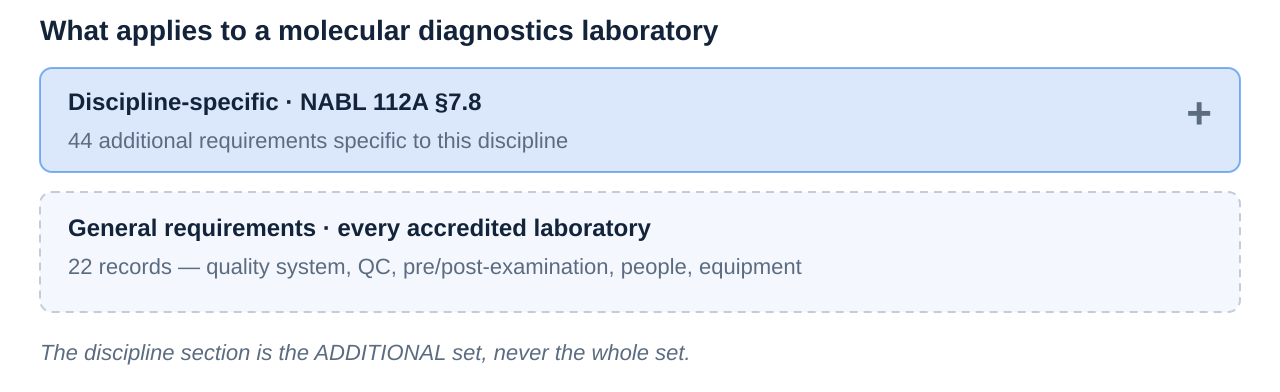
These are the requirements NABL applies specifically to Molecular Diagnostics, quoted from NABL 112A. They sit on top of the general requirements every accredited laboratory must meet, not instead of them.
What NABL 112A requires of this discipline
- The laboratory design shall ensure unidirectional workflow that prevents contamination of samples or reagents.
- Long distance shipping of clinical samples for nucleic acid studies shall be in dry ice.
- If samples cannot be tested immediately, they shall be processed and aliquoted in a biosafety cabinet and stored at (-)80°C.
- If RNA is to be extracted from a tissue sample, it shall be either snap frozen prior to storage at (-)80°C or lower, placed in a stabilizing solution, or processed for RNA extraction within 1 hour of collection.
- RNA/ DNA extraction shall be performed by validated in-house methods or verified commercial kits.
- Repeated freezing and thawing of samples shall be avoided by prior aliquoting.
- As RNA degrades rapidly, the laboratory shall have a policy about the receipt of transported samples for RNA based assays.
- However, for precious but delayed samples, negative results shall be interpreted with caution.
- A comment shall be added in the final report highlighting this issue.
Showing 9 of 44 discipline-specific requirements identified in section 7.8. Read the full section in the official document before an assessment — this page is a guide to it, not a replacement for it.
Verbatim excerpts from NABL 112A - Specific Criteria for Accreditation of Medical Laboratories, Issue 01, 18-Dec-2024, section 7 (Technical Requirements - Discipline Wise). Downloaded from nabl-india.org 2026-09-23. Download the current version from NABL →
Records this discipline still has to produce
The discipline criteria above are additional. Every accredited laboratory, in every discipline, must still maintain the general record set:
- NABL Internal Audit Checklist for Medical Laboratories
- Internal Quality Control (IQC) Record and Levey–Jennings Chart
- EQA / Proficiency Testing Participation Record
- Method Verification Record
- Method Validation Record
- Measurement Uncertainty (MU) Record
- Comparability of Results Record
- Quality Indicators Record
- Sample Rejection Log and Rejection Criteria
- Primary Sample Collection Manual
Other disciplines
- Clinical Biochemistry Cl. 7.1
- Clinical Pathology Cl. 7.2
- Haematology & Immunohaematology Cl. 7.3
- Microbiology & Infectious Disease Serology Cl. 7.4
- Histopathology Cl. 7.5
- Cytopathology Cl. 7.6
- Flow Cytometry Cl. 7.7
- Histocompatibility and Immunogenetics Cl. 7.9
- Cytogenetics Cl. 7.10
- Point of Care Testing (POCT) Cl. 7.11
HealthFlow is not NABL accredited and is not an accreditation body. Using it does not make a laboratory accredited or compliant. These pages describe what the standard requires; meeting it is the laboratory's own responsibility.
What the software contributes is evidence produced by normal work: turnaround time measured per test, reports versioned and locked on authorisation with dual signatures, every report access written to an append-only audit trail enforced at the database and retained two years, and full export whenever you want it.