
Widal Test with Malarial Parasite report format
A Widal report format with Salmonella O/H/AH/BH titres alongside the malarial parasite result.
Report layout used at Sobhana Diagnostics, signed by Dr. V. Aruna Sree, MBBS, DCP · Consultant Pathologist
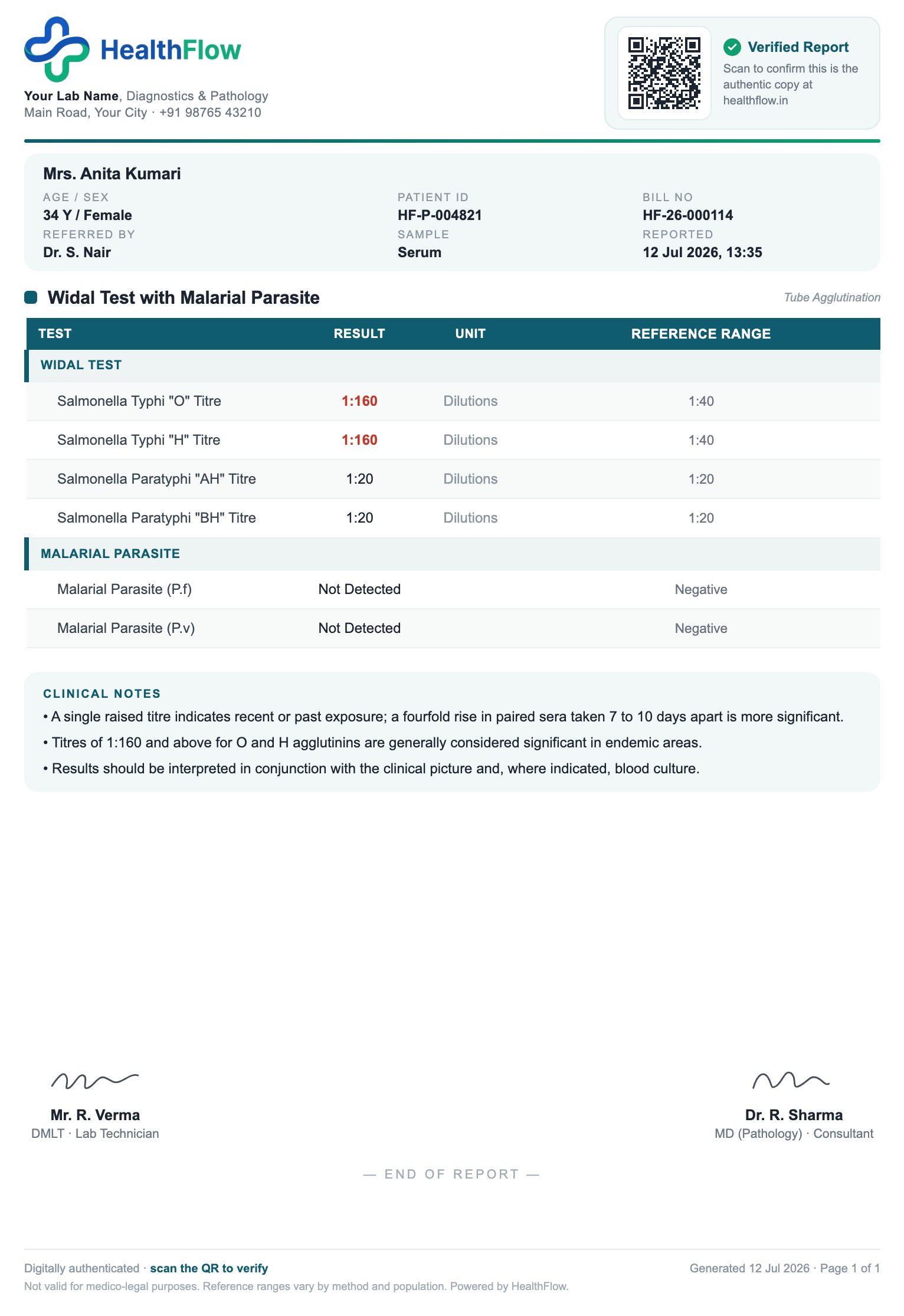
Sample format. "Your Lab Name" is a placeholder. On HealthFlow every report carries your lab's own logo, letterhead and colours, and the QR opens the authentic signed copy through a logged verification gateway.
What this Widal & Malarial Parasite format includes
Every line carries the result, its unit and the reference range, with out-of-range values flagged. The values below are sample values, shown so you can see the layout.
| Test | Result | Unit | Reference range |
|---|---|---|---|
| Widal Test | |||
| Salmonella Typhi "O" Titre | 1:160 | Dilutions | 1:40 |
| Salmonella Typhi "H" Titre | 1:160 | Dilutions | 1:40 |
| Salmonella Paratyphi "AH" Titre | 1:20 | Dilutions | 1:20 |
| Salmonella Paratyphi "BH" Titre | 1:20 | Dilutions | 1:20 |
| Malarial Parasite | |||
| Malarial Parasite (P.f) | Not Detected | Negative | |
| Malarial Parasite (P.v) | Not Detected | Negative | |
How a Widal & Malarial Parasite report is read
- A single raised titre indicates recent or past exposure; a fourfold rise in paired sera taken 7 to 10 days apart is more significant.
- Titres of 1:160 and above for O and H agglutinins are generally considered significant in endemic areas.
- Results should be interpreted in conjunction with the clinical picture and, where indicated, blood culture.
What commonly goes wrong with a Widal & Malarial Parasite
The practical errors that actually cause repeat samples and misread results, mostly at collection and at the point the result is read.
- A single Widal titre cannot diagnose enteric fever in India, because background agglutinin titres from past or subclinical exposure are common and the significant cut-off differs between populations. The meaningful finding is a four-fold rise between paired samples taken about 7 to 10 days apart.
- Agglutinins usually appear only towards the end of the first week of illness, so a Widal drawn on day 2 or 3 of fever is expected to be negative and does not exclude typhoid.
- The slide method is a screening step only. A reportable titre comes from the quantitative tube test run with positive and negative controls, and slide-only reporting is a well recognised source of over-diagnosis.
- Anti-H agglutinins persist for long periods after past infection, so a raised H titre with a low O titre is not evidence of current infection. Cross reactions with malaria, dengue and other febrile illnesses are well described and are a common source of false positives.
Want this Widal & Malarial Parasite format for your own lab?
Looking for prices instead? See the cost of this test in India.
What does a Widal & Malarial Parasite report format include?
A Widal report format with Salmonella O/H/AH/BH titres alongside the malarial parasite result. Each line shows the result, its unit and the reference range, with out-of-range values flagged, followed by clinical notes on how the test is interpreted.
Can this Widal & Malarial Parasite format carry my lab's brand?
Yes. On HealthFlow the report is white-label: your lab's logo, letterhead, address and colours replace the "Your Lab Name" placeholder, and it can be printed or delivered on WhatsApp from your own number.