
Viral Screen (HIV, HBsAg, HCV, VDRL) report format
A viral screen report format covering HIV 1 and 2, HBsAg, HCV and VDRL, used for pre-operative and routine screening.
Report layout used at Sobhana Diagnostics, signed by Dr. V. Aruna Sree, MBBS, DCP · Consultant Pathologist
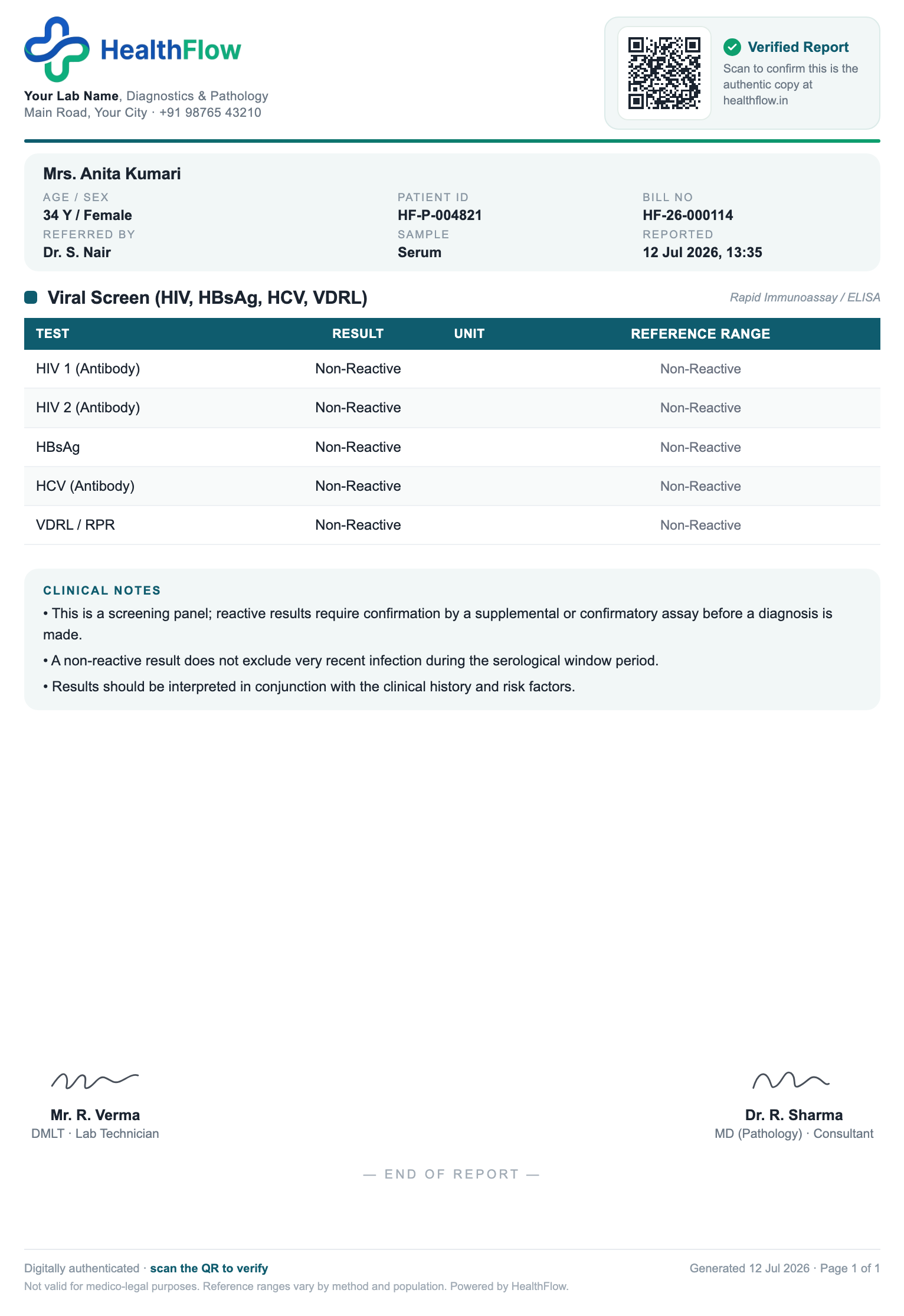
Sample format. "Your Lab Name" is a placeholder. On HealthFlow every report carries your lab's own logo, letterhead and colours, and the QR opens the authentic signed copy through a logged verification gateway.
What this Viral Screen (HIV, HBsAg, HCV, VDRL) format includes
Every line carries the result, its unit and the reference range, with out-of-range values flagged. The values below are sample values, shown so you can see the layout.
| Test | Result | Reference range |
|---|---|---|
| HIV 1 (Antibody) | Non-Reactive | Non-Reactive |
| HIV 2 (Antibody) | Non-Reactive | Non-Reactive |
| HBsAg | Non-Reactive | Non-Reactive |
| HCV (Antibody) | Non-Reactive | Non-Reactive |
| VDRL / RPR | Non-Reactive | Non-Reactive |
How a Viral Screen (HIV, HBsAg, HCV, VDRL) report is read
- This is a screening panel; reactive results require confirmation by a supplemental or confirmatory assay before a diagnosis is made.
- A non-reactive result does not exclude very recent infection during the serological window period.
- Results should be interpreted in conjunction with the clinical history and risk factors.
What commonly goes wrong with a Viral Screen (HIV, HBsAg, HCV, VDRL)
The practical errors that actually cause repeat samples and misread results, mostly at collection and at the point the result is read.
- Every one of these tests has a window period, so a negative result taken soon after a suspected exposure does not exclude infection and needs repeat testing at the appropriate interval. Fourth generation HIV assays shorten that window but do not abolish it.
- A reactive screening result is not a diagnosis. HIV requires confirmation through the national three-test algorithm, and a reactive HBsAg or anti-HCV screen needs confirmation before anything is issued to the patient.
- Anti-HCV detects antibody, so a reactive result cannot distinguish current infection from past cleared infection. Only HCV RNA answers that question, and reporting a reactive antibody as 'hepatitis C positive' is a real and common harm.
- Initially reactive results and results near the assay cut-off must be repeated in duplicate before reporting rather than issued off a single run. HIV testing in India also carries statutory requirements for informed consent and confidentiality, so results cannot be handed to relatives or sent to a shared number.
Want this Viral Screen (HIV, HBsAg, HCV, VDRL) format for your own lab?
Looking for prices instead? See the cost of this test in India.
What does a Viral Screen (HIV, HBsAg, HCV, VDRL) report format include?
A viral screen report format covering HIV 1 and 2, HBsAg, HCV and VDRL, used for pre-operative and routine screening. Each line shows the result and the reference range, with out-of-range values flagged, followed by clinical notes on how the test is interpreted.
Can this Viral Screen (HIV, HBsAg, HCV, VDRL) format carry my lab's brand?
Yes. On HealthFlow the report is white-label: your lab's logo, letterhead, address and colours replace the "Your Lab Name" placeholder, and it can be printed or delivered on WhatsApp from your own number.