
Urine Culture & Sensitivity report format
A urine culture and sensitivity report format with the organism isolated and an antibiotic sensitivity panel.
Based on the report layout used at Sobhana Diagnostics, Hyderabad, where reports are signed by Dr. V. Aruna Sree, MBBS, DCP · Consultant Pathologist
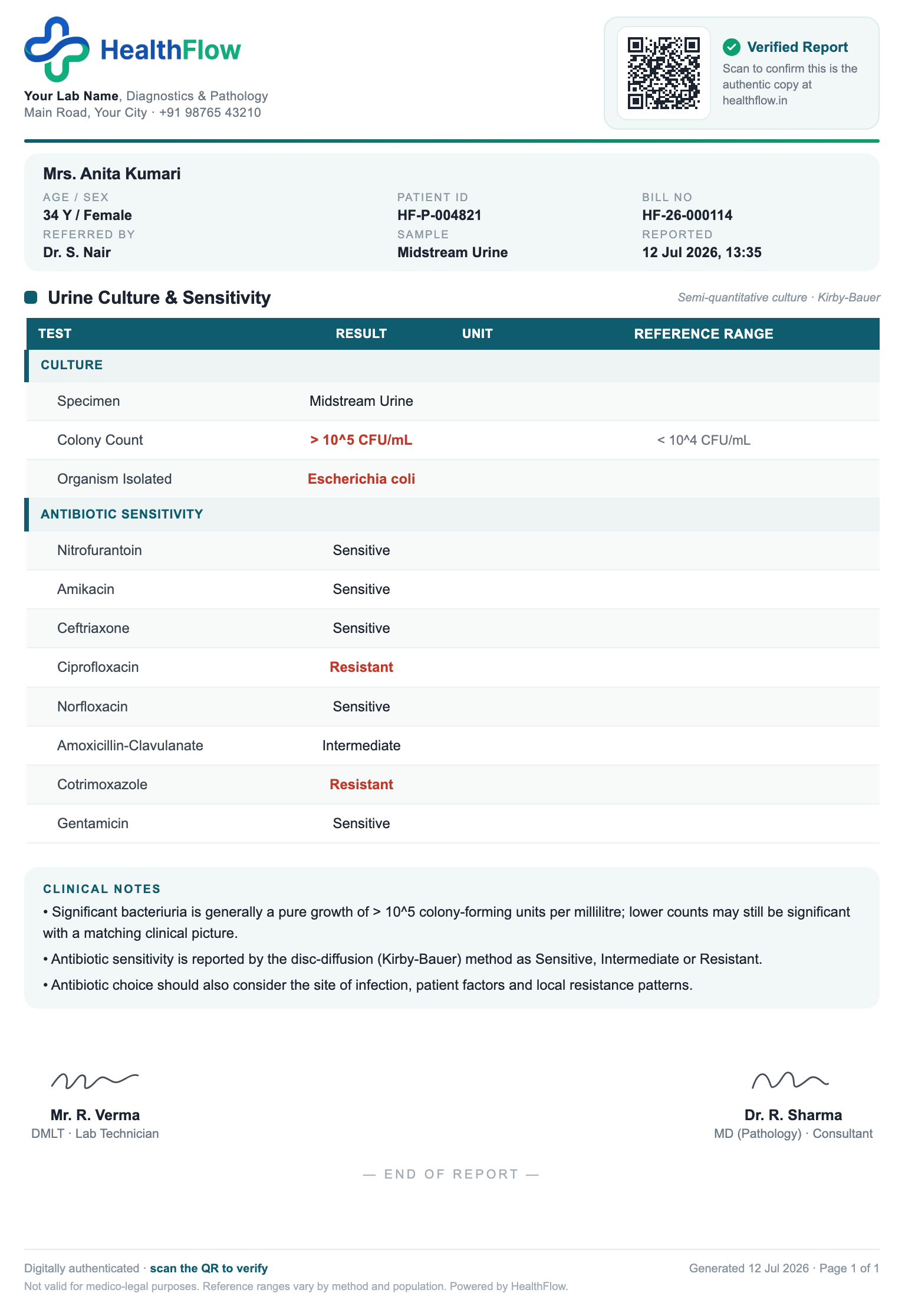
Sample format. "Your Lab Name" is a placeholder. On HealthFlow every report carries your lab's own logo, letterhead and colours, and the QR opens the authentic signed copy through a logged verification gateway.
What this Urine Culture & Sensitivity format includes
Every line carries the result, its unit and the reference range, with out-of-range values flagged. The values below are sample values, shown so you can see the layout.
| Test | Result | Reference range |
|---|---|---|
| Culture | ||
| Specimen | Midstream Urine | |
| Colony Count | > 10^5 CFU/mL | < 10^4 CFU/mL |
| Organism Isolated | Escherichia coli | |
| Antibiotic Sensitivity | ||
| Nitrofurantoin | Sensitive | |
| Amikacin | Sensitive | |
| Ceftriaxone | Sensitive | |
| Ciprofloxacin | Resistant | |
| Norfloxacin | Sensitive | |
| Amoxicillin-Clavulanate | Intermediate | |
| Cotrimoxazole | Resistant | |
| Gentamicin | Sensitive | |
How a Urine Culture & Sensitivity report is read
- Significant bacteriuria is generally a pure growth of > 10^5 colony-forming units per millilitre; lower counts may still be significant with a matching clinical picture.
- Antibiotic sensitivity is reported by the disc-diffusion (Kirby-Bauer) method as Sensitive, Intermediate or Resistant.
- Antibiotic choice should also consider the site of infection, patient factors and local resistance patterns.
What commonly goes wrong with a Urine Culture & Sensitivity
The practical errors that actually cause repeat samples and misread results, mostly at collection and at the point the result is read.
- Any organism already in the urine, contaminant or pathogen, multiplies at room temperature and inflates the colony count. Set the culture up within two hours of collection or refrigerate at 2 to 8 degrees Celsius, and record the collection time on the form so a delayed sample can be recognised.
- Growth of three or more organisms from a voided sample is treated as contamination. It is reported as mixed growth with a request for a repeat clean-catch sample, not issued as a polymicrobial infection with sensitivities.
- A sample taken after antibiotics have already been started is often sterile or shows a suppressed count. The culture should be collected before the first dose, and where it was not, that has to be noted on the report.
- The classic significant count of 10 to the power 5 CFU per mL is a guide, not an absolute rule, since lower counts can be significant depending on symptoms, sex and how the sample was taken. A catheter specimen must be drawn from the sampling port and never from the drainage bag.
Want this Urine Culture & Sensitivity format for your own lab?
Looking for prices instead? See the cost of this test in India.
What does a Urine Culture & Sensitivity report format include?
A urine culture and sensitivity report format with the organism isolated and an antibiotic sensitivity panel. Each line shows the result and the reference range, with out-of-range values flagged, followed by clinical notes on how the test is interpreted.
Can this Urine Culture & Sensitivity format carry my lab's brand?
Yes. On HealthFlow the report is white-label: your lab's logo, letterhead, address and colours replace the "Your Lab Name" placeholder, and it can be printed or delivered on WhatsApp in your lab's name (from your own number on Premium).