
Gram Stain report format
A Gram stain report format with the Gram reaction and microscopy findings.
Report layout used at Sobhana Diagnostics, signed by Dr. V. Aruna Sree, MBBS, DCP · Consultant Pathologist
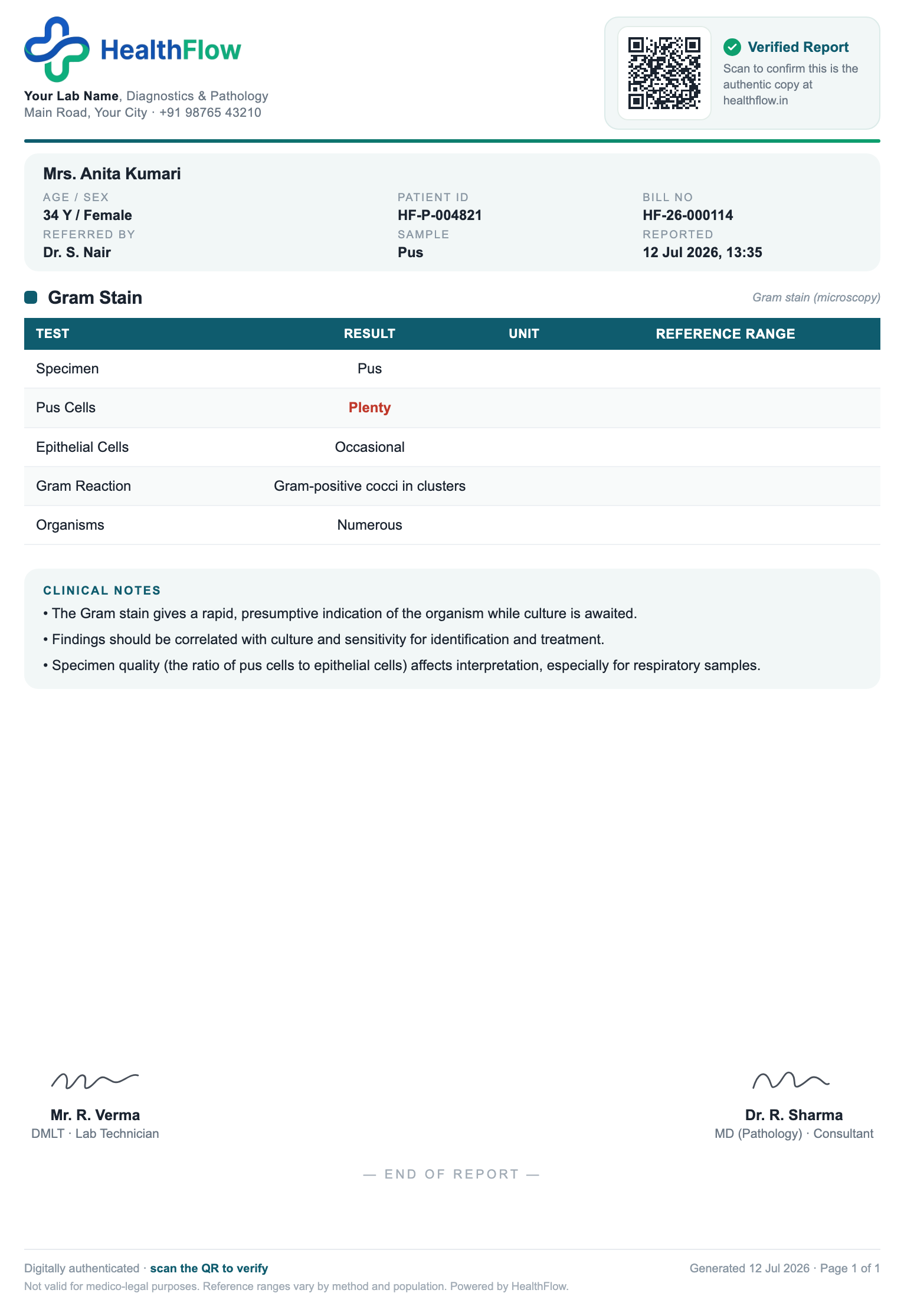
Sample format. "Your Lab Name" is a placeholder. On HealthFlow every report carries your lab's own logo, letterhead and colours, and the QR opens the authentic signed copy through a logged verification gateway.
What this Gram Stain format includes
This is a qualitative test: the result is the finding itself, so there is no numeric unit or reference range to report. The values below are sample values, shown so you can see the layout.
| Test | Result |
|---|---|
| Specimen | Pus |
| Pus Cells | Plenty |
| Epithelial Cells | Occasional |
| Gram Reaction | Gram-positive cocci in clusters |
| Organisms | Numerous |
How a Gram Stain report is read
- The Gram stain gives a rapid, presumptive indication of the organism while culture is awaited.
- Findings should be correlated with culture and sensitivity for identification and treatment.
- Specimen quality (the ratio of pus cells to epithelial cells) affects interpretation, especially for respiratory samples.
What commonly goes wrong with a Gram Stain
The practical errors that actually cause repeat samples and misread results, mostly at collection and at the point the result is read.
- Over-decolourisation turns gram-positive organisms gram-negative and is the single most common technical error. A smear that is too thick decolourises unevenly, so a heavy area can read positive while a thin area of the same slide reads negative.
- A Gram stain reports morphology, not identity. "Gram-positive cocci in clusters" is the correct report; naming an organism belongs to the culture, not to the smear.
- A sputum smear loaded with squamous epithelial cells is mouth contamination, not lower respiratory material, and should be flagged or rejected rather than reported as a respiratory pathogen.
- Always report the pus cell picture alongside the organisms. Organisms with no inflammatory cells often mean colonisation or a contaminated collection, and that context is lost if only the organism line is issued.
Want this Gram Stain format for your own lab?
What does a Gram Stain report format include?
A Gram stain report format with the Gram reaction and microscopy findings. This is a qualitative test, so each line reports the finding itself rather than a numeric unit or reference range, followed by clinical notes on how the test is interpreted.
Can this Gram Stain format carry my lab's brand?
Yes. On HealthFlow the report is white-label: your lab's logo, letterhead, address and colours replace the "Your Lab Name" placeholder, and it can be printed or delivered on WhatsApp from your own number.