
Renal Function Test with Electrolytes report format
A renal-function report format with urea, creatinine, uric acid and serum electrolytes (sodium, potassium, chloride).
Report layout used at Sobhana Diagnostics, signed by Dr. V. Aruna Sree, MBBS, DCP · Consultant Pathologist
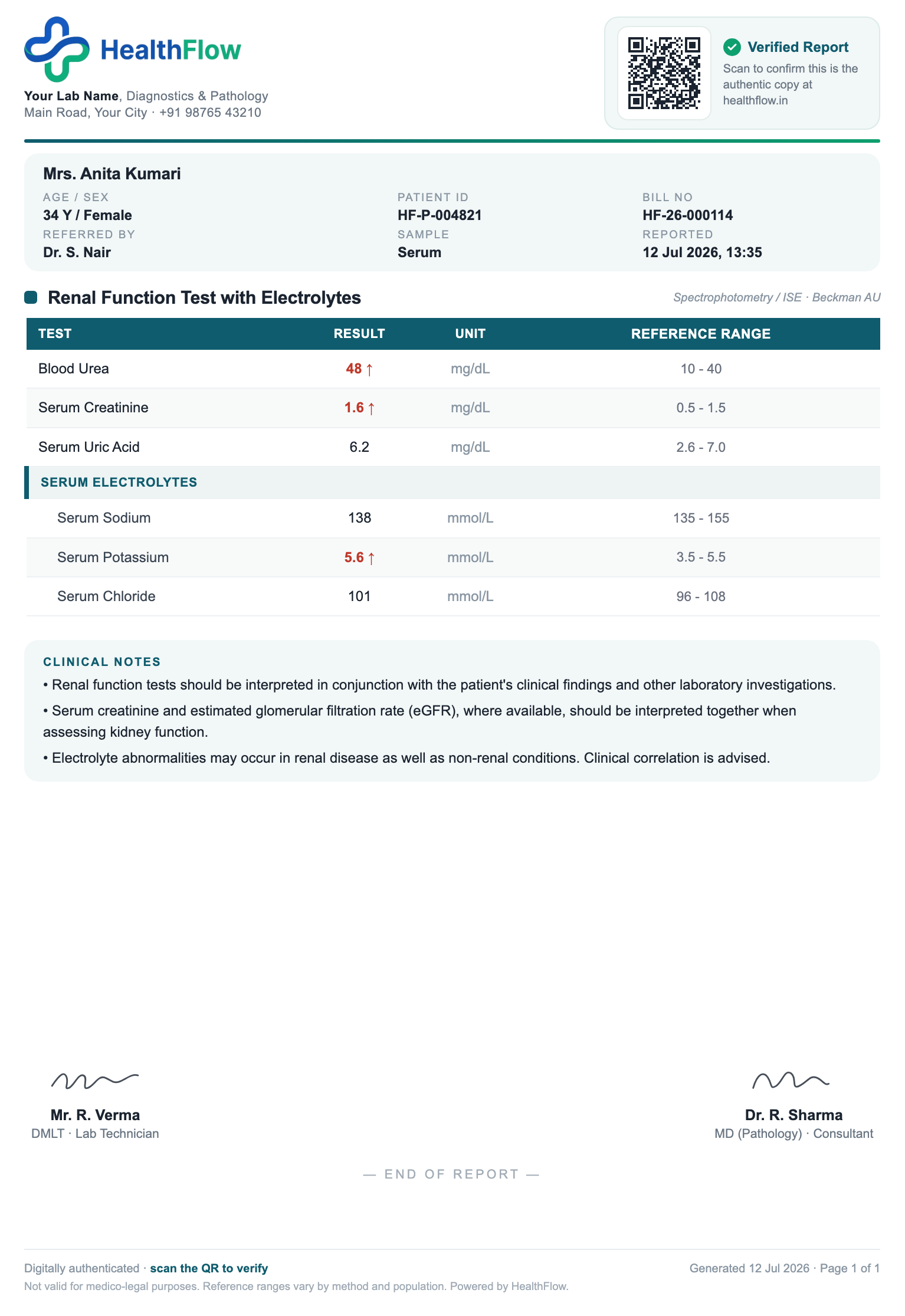
Sample format. "Your Lab Name" is a placeholder. On HealthFlow every report carries your lab's own logo, letterhead and colours, and the QR opens the authentic signed copy through a logged verification gateway.
What this Renal Function Test format includes
Every line carries the result, its unit and the reference range, with out-of-range values flagged. The values below are sample values, shown so you can see the layout.
| Test | Result | Unit | Reference range |
|---|---|---|---|
| Blood Urea | 48 ↑ | mg/dL | 10 - 40 |
| Serum Creatinine | 1.6 ↑ | mg/dL | 0.5 - 1.5 |
| Serum Uric Acid | 6.2 | mg/dL | 2.6 - 7.0 |
| Serum Electrolytes | |||
| Serum Sodium | 138 | mmol/L | 135 - 155 |
| Serum Potassium | 5.6 ↑ | mmol/L | 3.5 - 5.5 |
| Serum Chloride | 101 | mmol/L | 96 - 108 |
How a Renal Function Test report is read
- Renal function tests should be interpreted in conjunction with the patient's clinical findings and other laboratory investigations.
- Serum creatinine and estimated glomerular filtration rate (eGFR), where available, should be interpreted together when assessing kidney function.
- Electrolyte abnormalities may occur in renal disease as well as non-renal conditions. Clinical correlation is advised.
What commonly goes wrong with a Renal Function Test
The practical errors that actually cause repeat samples and misread results, mostly at collection and at the point the result is read.
- Blood urea and BUN are not the same number. Blood urea is about 2.14 times BUN, and printing a urea value against a BUN reference range, or the reverse, is one of the commonest report errors on this panel.
- eGFR cannot be issued without age and sex, and it assumes a steady state. In a patient whose creatinine is moving quickly up or down, the eGFR printed beside it is not valid.
- A creatinine inside the reference range does not mean normal kidneys. A substantial share of function can be lost before creatinine leaves the range, and in a thin or elderly patient with low muscle mass it stays low for longer still.
- When the panel carries electrolytes, the potassium follows sample-handling rules, not the patient: haemolysed blood, or blood left unseparated, gives a falsely high potassium and should be recollected.
Want this Renal Function Test format for your own lab?
Looking for prices instead? See the cost of this test in India.
What does a Renal Function Test report format include?
A renal-function report format with urea, creatinine, uric acid and serum electrolytes (sodium, potassium, chloride). Each line shows the result, its unit and the reference range, with out-of-range values flagged, followed by clinical notes on how the test is interpreted.
Can this Renal Function Test format carry my lab's brand?
Yes. On HealthFlow the report is white-label: your lab's logo, letterhead, address and colours replace the "Your Lab Name" placeholder, and it can be printed or delivered on WhatsApp from your own number.