
High-Sensitivity CRP (hs-CRP) report format
A high-sensitivity CRP report format with the cardiovascular-risk interpretation bands.
Report layout used at Sobhana Diagnostics, signed by Dr. V. Aruna Sree, MBBS, DCP · Consultant Pathologist
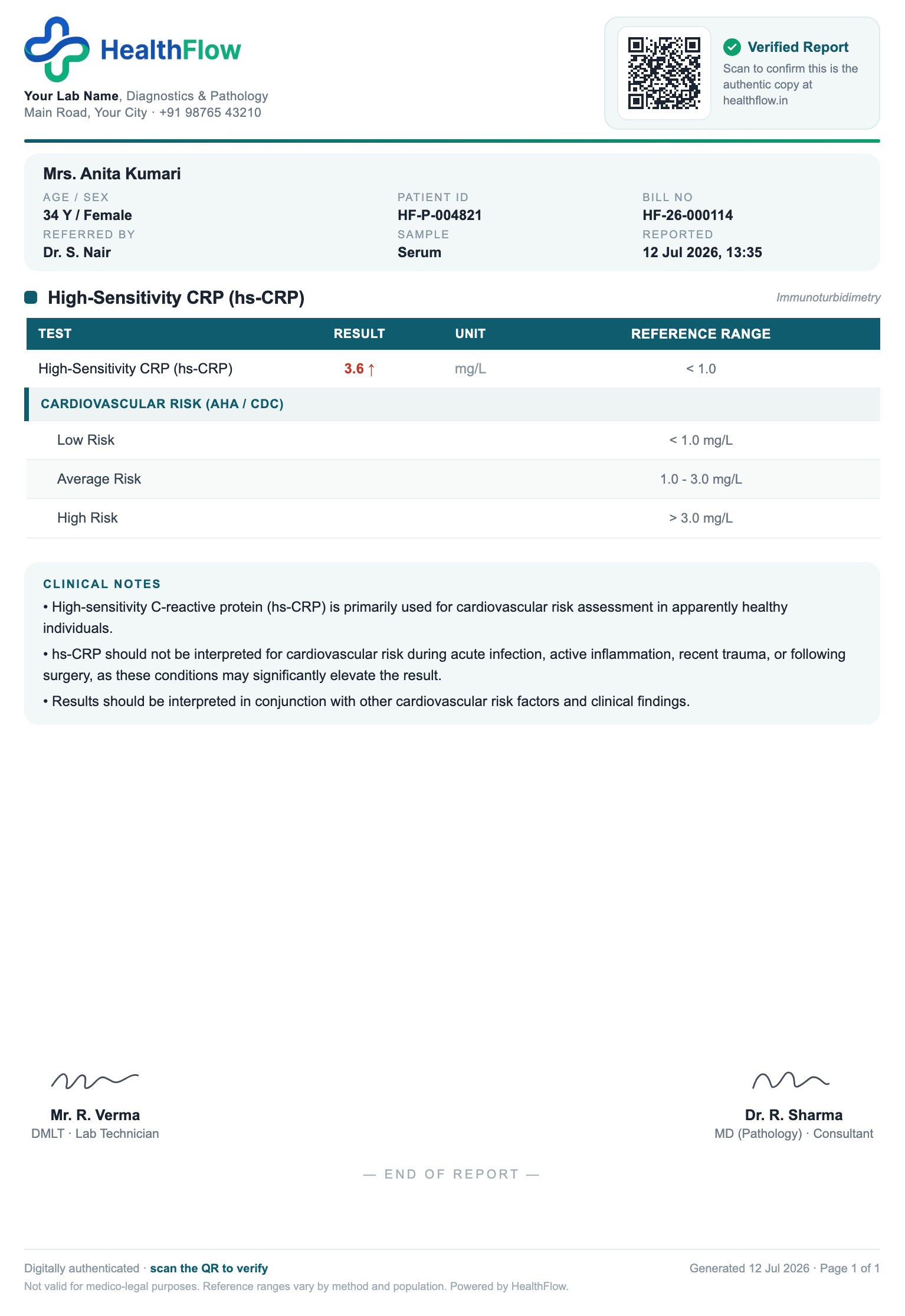
Sample format. "Your Lab Name" is a placeholder. On HealthFlow every report carries your lab's own logo, letterhead and colours, and the QR opens the authentic signed copy through a logged verification gateway.
What this High-Sensitivity CRP format includes
Every line carries the result, its unit and the reference range, with out-of-range values flagged. The values below are sample values, shown so you can see the layout.
| Test | Result | Unit | Reference range |
|---|---|---|---|
| High-Sensitivity CRP (hs-CRP) | 3.6 ↑ | mg/L | < 1.0 |
| Cardiovascular Risk (AHA / CDC) | |||
| Low Risk | < 1.0 mg/L | ||
| Average Risk | 1.0 - 3.0 mg/L | ||
| High Risk | > 3.0 mg/L | ||
How a High-Sensitivity CRP report is read
- High-sensitivity C-reactive protein (hs-CRP) is primarily used for cardiovascular risk assessment in apparently healthy individuals.
- hs-CRP should not be interpreted for cardiovascular risk during acute infection, active inflammation, recent trauma, or following surgery, as these conditions may significantly elevate the result.
- Results should be interpreted in conjunction with other cardiovascular risk factors and clinical findings.
What commonly goes wrong with a High-Sensitivity CRP
The practical errors that actually cause repeat samples and misread results, mostly at collection and at the point the result is read.
- hs-CRP and ordinary CRP measure the same protein and differ only in how far down the assay can discriminate. A standard CRP assay cannot be reported as hs-CRP, because it cannot separate values inside the low range where the whole test does its work.
- A value above 10 mg/L points to intercurrent infection, injury or an inflammatory flare rather than to baseline vascular risk. Conventional practice is to leave such a value out of risk assessment and repeat once the patient has recovered.
- Because single values vary from day to day, risk banding is conventionally based on the average of two measurements taken about two weeks apart in a metabolically stable patient.
- Ordering hs-CRP to follow an infection or a post-operative course wastes the assay's sensitivity. Ordinary CRP covers that range perfectly well and costs less.
Want this High-Sensitivity CRP format for your own lab?
Looking for prices instead? See the cost of this test in India.
What does a High-Sensitivity CRP report format include?
A high-sensitivity CRP report format with the cardiovascular-risk interpretation bands. Each line shows the result, its unit and the reference range, with out-of-range values flagged, followed by clinical notes on how the test is interpreted.
Can this High-Sensitivity CRP format carry my lab's brand?
Yes. On HealthFlow the report is white-label: your lab's logo, letterhead, address and colours replace the "Your Lab Name" placeholder, and it can be printed or delivered on WhatsApp from your own number.