
Inflammatory Markers (CRP & ESR) report format
An inflammatory-marker report format pairing C-reactive protein (CRP) with the erythrocyte sedimentation rate (ESR).
Report layout used at Sobhana Diagnostics, signed by Dr. V. Aruna Sree, MBBS, DCP · Consultant Pathologist
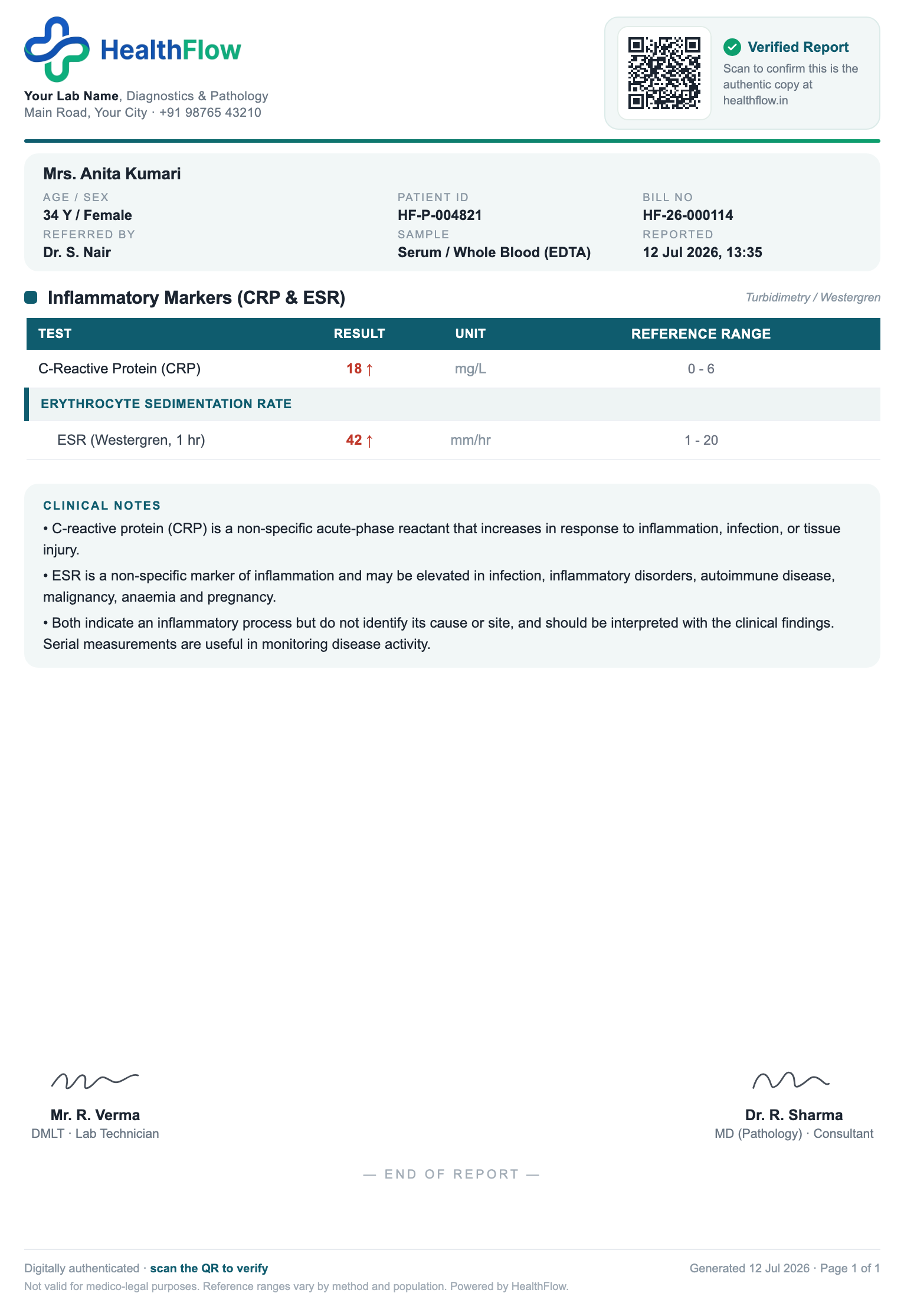
Sample format. "Your Lab Name" is a placeholder. On HealthFlow every report carries your lab's own logo, letterhead and colours, and the QR opens the authentic signed copy through a logged verification gateway.
What this CRP & ESR format includes
Every line carries the result, its unit and the reference range, with out-of-range values flagged. The values below are sample values, shown so you can see the layout.
| Test | Result | Unit | Reference range |
|---|---|---|---|
| C-Reactive Protein (CRP) | 18 ↑ | mg/L | 0 - 6 |
| Erythrocyte Sedimentation Rate | |||
| ESR (Westergren, 1 hr) | 42 ↑ | mm/hr | 1 - 20 |
How a CRP & ESR report is read
- C-reactive protein (CRP) is a non-specific acute-phase reactant that increases in response to inflammation, infection, or tissue injury.
- ESR is a non-specific marker of inflammation and may be elevated in infection, inflammatory disorders, autoimmune disease, malignancy, anaemia and pregnancy.
- Both indicate an inflammatory process but do not identify its cause or site, and should be interpreted with the clinical findings. Serial measurements are useful in monitoring disease activity.
What commonly goes wrong with a CRP & ESR
The practical errors that actually cause repeat samples and misread results, mostly at collection and at the point the result is read.
- The two markers move on different clocks. CRP rises within hours and falls quickly once inflammation settles, while ESR takes days to rise and weeks to come down, so a high ESR alongside a normal CRP in a recovering patient is expected behaviour and not a laboratory error.
- ESR is a physical measurement and the setup decides the number. The tube needs the correct citrate to blood dilution, and the rack must stand truly vertical, away from vibration, draughts and direct sunlight, since even a slight tilt raises the reading.
- Run the ESR within about four hours of collection at room temperature. A sample left standing on the bench for half a day gives a falsely low result that will be read as improvement.
- Anaemia, pregnancy, older age and female sex all raise ESR on their own, with no inflammation involved. In a population where anaemia is very common, a raised ESR in isolation carries little information.
- A qualitative slide latex CRP result is not comparable with a quantitative CRP in mg/L. Only quantitative results can be trended between visits.
Want this CRP & ESR format for your own lab?
Looking for prices instead? See the cost of this test in India.
What does a CRP & ESR report format include?
An inflammatory-marker report format pairing C-reactive protein (CRP) with the erythrocyte sedimentation rate (ESR). Each line shows the result, its unit and the reference range, with out-of-range values flagged, followed by clinical notes on how the test is interpreted.
Can this CRP & ESR format carry my lab's brand?
Yes. On HealthFlow the report is white-label: your lab's logo, letterhead, address and colours replace the "Your Lab Name" placeholder, and it can be printed or delivered on WhatsApp from your own number.