
Glucose Tolerance Test (GTT) report format
A glucose tolerance test report format with fasting, 1-hour and 2-hour blood sugar after a 75 g oral glucose load.
Report layout used at Sobhana Diagnostics, signed by Dr. V. Aruna Sree, MBBS, DCP · Consultant Pathologist
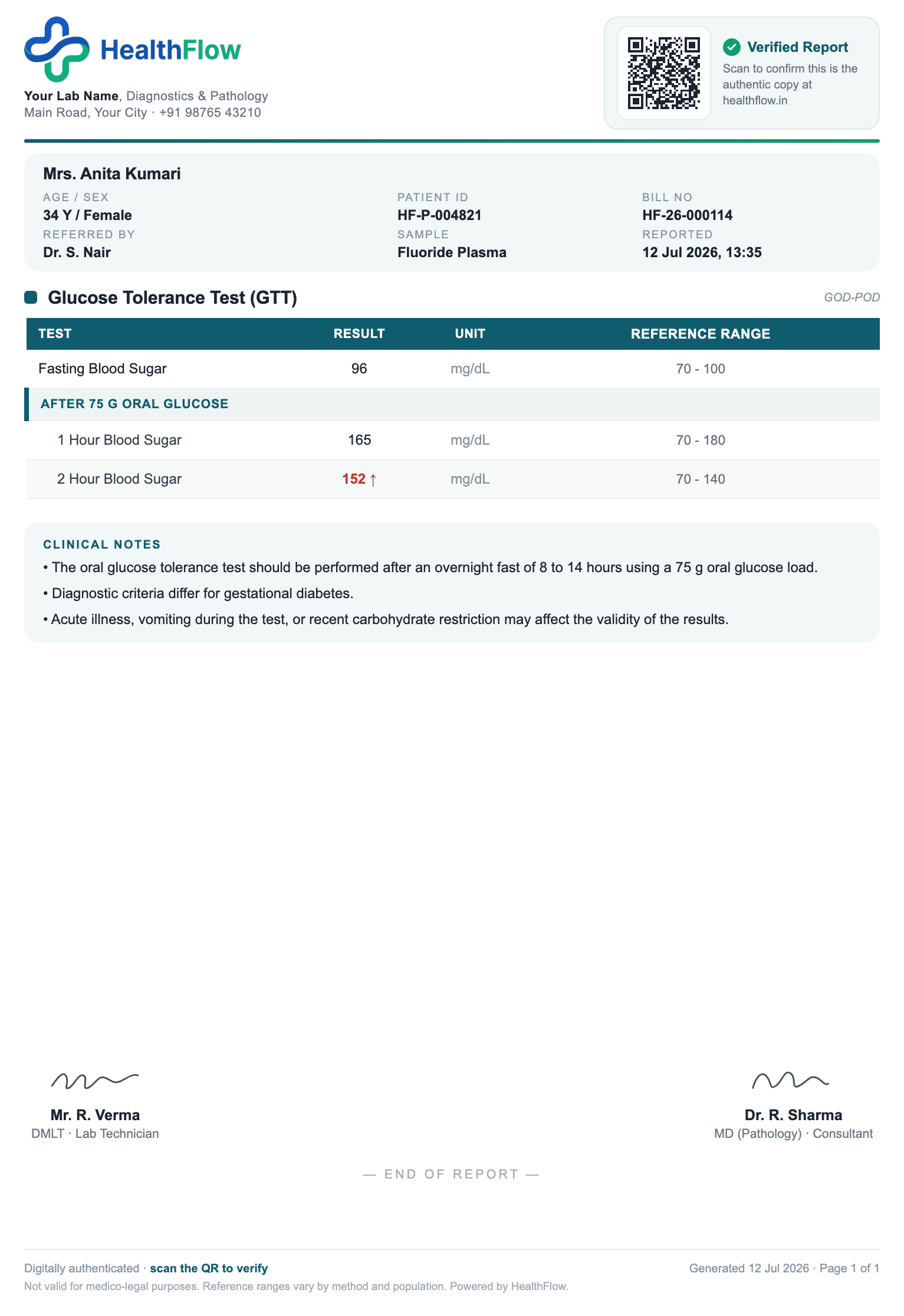
Sample format. "Your Lab Name" is a placeholder. On HealthFlow every report carries your lab's own logo, letterhead and colours, and the QR opens the authentic signed copy through a logged verification gateway.
What this Glucose Tolerance Test (GTT) format includes
Every line carries the result, its unit and the reference range, with out-of-range values flagged. The values below are sample values, shown so you can see the layout.
| Test | Result | Unit | Reference range |
|---|---|---|---|
| Fasting Blood Sugar | 96 | mg/dL | 70 - 100 |
| After 75 g Oral Glucose | |||
| 1 Hour Blood Sugar | 165 | mg/dL | 70 - 180 |
| 2 Hour Blood Sugar | 152 ↑ | mg/dL | 70 - 140 |
How a Glucose Tolerance Test (GTT) report is read
- The oral glucose tolerance test should be performed after an overnight fast of 8 to 14 hours using a 75 g oral glucose load.
- Diagnostic criteria differ for gestational diabetes.
- Acute illness, vomiting during the test, or recent carbohydrate restriction may affect the validity of the results.
What commonly goes wrong with a Glucose Tolerance Test (GTT)
The practical errors that actually cause repeat samples and misread results, mostly at collection and at the point the result is read.
- The patient must eat a normal unrestricted carbohydrate diet for three days before the test, roughly 150 g of carbohydrate a day. Patients who cut rice and roti to "prepare" for the test push their values up, not down.
- The clock starts at the first sip of the glucose load, not when the glass is empty. The load should be finished within about five minutes and each tube labelled with its time slot at the moment of draw, since swapped 1 hour and 2 hour tubes are a common error that leaves no trace on the report.
- The patient stays seated and at rest for the whole duration, with no smoking and no walking outside. If the patient vomits the load, the test is abandoned and repeated on another day, not reported with whatever samples were collected.
- Antenatal protocols differ, and the fasting 75 g WHO test and the non fasting 75 g DIPSI test are not the same procedure. Applying one protocol's cut-offs to the other's sampling is a frequent mix-up, so the request form and the report should both state which protocol was performed.
Want this Glucose Tolerance Test (GTT) format for your own lab?
Looking for prices instead? See the cost of this test in India.
What does a Glucose Tolerance Test (GTT) report format include?
A glucose tolerance test report format with fasting, 1-hour and 2-hour blood sugar after a 75 g oral glucose load. Each line shows the result, its unit and the reference range, with out-of-range values flagged, followed by clinical notes on how the test is interpreted.
Can this Glucose Tolerance Test (GTT) format carry my lab's brand?
Yes. On HealthFlow the report is white-label: your lab's logo, letterhead, address and colours replace the "Your Lab Name" placeholder, and it can be printed or delivered on WhatsApp from your own number.