
Absolute Eosinophil Count (AEC) report format
An absolute eosinophil count (AEC) report format with reference range and clinical notes.
Report layout used at Sobhana Diagnostics, signed by Dr. V. Aruna Sree, MBBS, DCP · Consultant Pathologist
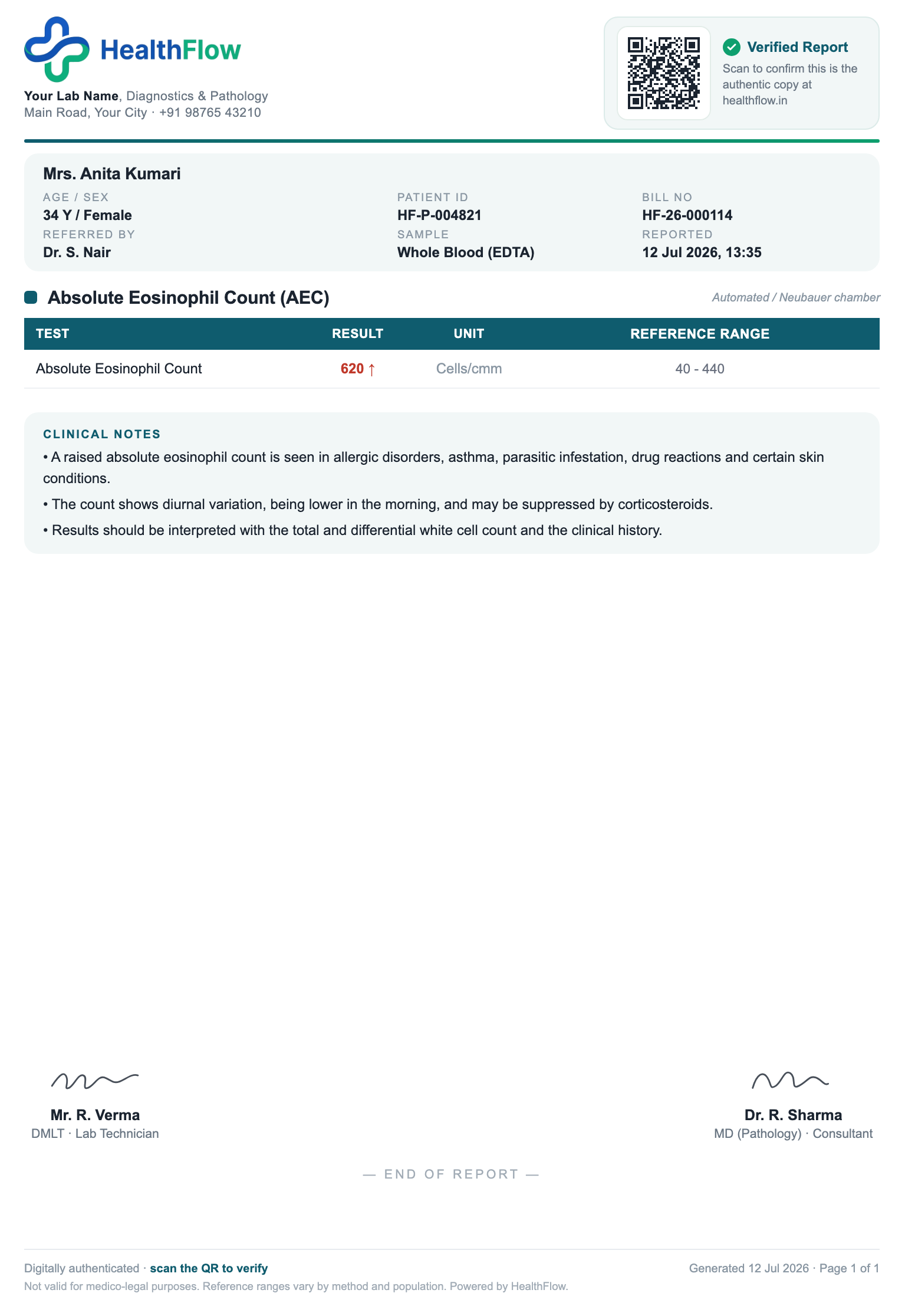
Sample format. "Your Lab Name" is a placeholder. On HealthFlow every report carries your lab's own logo, letterhead and colours, and the QR opens the authentic signed copy through a logged verification gateway.
What this Absolute Eosinophil Count format includes
Every line carries the result, its unit and the reference range, with out-of-range values flagged. The values below are sample values, shown so you can see the layout.
| Test | Result | Unit | Reference range |
|---|---|---|---|
| Absolute Eosinophil Count | 620 ↑ | Cells/cmm | 40 - 440 |
How a Absolute Eosinophil Count report is read
- A raised absolute eosinophil count is seen in allergic disorders, asthma, parasitic infestation, drug reactions and certain skin conditions.
- The count shows diurnal variation, being lower in the morning, and may be suppressed by corticosteroids.
- Results should be interpreted with the total and differential white cell count and the clinical history.
What commonly goes wrong with a Absolute Eosinophil Count
The practical errors that actually cause repeat samples and misread results, mostly at collection and at the point the result is read.
- The absolute count is the total WBC multiplied by the eosinophil percentage, so the percentage on its own is not the AEC. A normal looking percentage sitting on a high total WBC still gives a raised absolute count, and a high percentage on a low WBC often does not.
- Eosinophil counts follow a daily rhythm and are at their lowest in the morning. Serial samples on the same patient should be collected at roughly the same time of day or the trend is meaningless.
- Recent corticosteroid exposure sharply lowers circulating eosinophils and can mask a genuinely raised count, so the result should always be read against what the patient has recently taken.
- Manual chamber counts using a haemocytometer are imprecise, particularly at low counts, because so few cells are actually counted. Small differences between two reports are usually method noise rather than a real change.
Want this Absolute Eosinophil Count format for your own lab?
What does a Absolute Eosinophil Count report format include?
An absolute eosinophil count (AEC) report format with reference range and clinical notes. Each line shows the result, its unit and the reference range, with out-of-range values flagged, followed by clinical notes on how the test is interpreted.
Can this Absolute Eosinophil Count format carry my lab's brand?
Yes. On HealthFlow the report is white-label: your lab's logo, letterhead, address and colours replace the "Your Lab Name" placeholder, and it can be printed or delivered on WhatsApp from your own number.